

03 Oct Ancestry- Newsletter- October 3, 2026
ANCESTRY- THE NEWSLETTER PODCAST STYLE!
You can now listen as well as read the Dancestors Genealogy Newsletter.
Listen to all Dancestors Genealogy newsletters on our podcast page.
PODCASTS
 ANCESTRY- CHOOSING TEXAS; A LEGEND OF CATTLE, COMANCHES AND A PROMISE KEPT
 ANCESTRY- CHOOSING TEXAS; A LEGEND OF CATTLE, COMANCHES AND A PROMISE KEPT
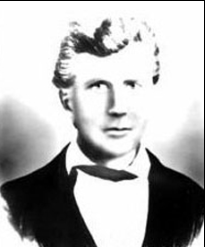
One of my client’s 6th Great Uncles, Oliver “Bob” Loving (pictured below) was born in 1812 in KY. In 1843, with his brother and his brother-in-law, he moved to the Republic of Texas with their families. In Texas, Loving received 640 acres of land in three patents spread through three counties Collin, Dallas, and Parker. He farmed and, to feed his growing family, hauled freight in his early years as a Texan.
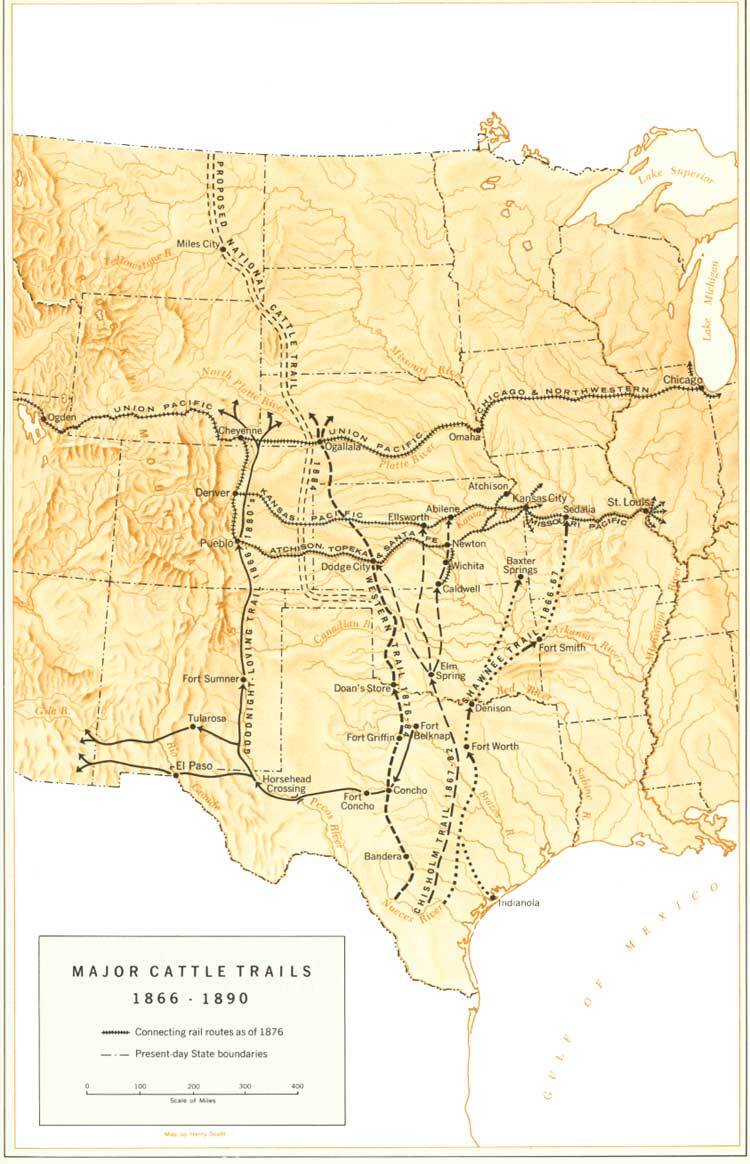
By 1855, he moved with his family to the future Pleasant, Palo Pinto County, Texas, where he ran a country store and ranched on Keechi Creek. He was quite prosperous and worth over $37,000 as of 1860. By 1857, he owned a thousand acres of land. To market his large herd, he drove them out of Texas and in that same year he entrusted his nineteen-year-old son, Joseph, to drive his and his neighbors’ cattle to Illinois up the Shawnee Trail. The drive made a profit of $36 a head and encouraged Loving to repeat the trek successfully the next year with John Durkee.
On August 29, 1860, together with John Dawson, he started a herd of 1,500 toward Denver, Colorado to feed miners in the area. They crossed the Red River, traveled to the Arkansas River, and followed it to Pueblo, Colorado, where the cattle wintered. In the spring, Loving sold his cattle for gold and tried to leave for Texas. However, the American Civil War had broken out and the Union authorities prevented him from returning to the South until Kit Carson and others interceded for him. During the war, he was commissioned to provide beef to the Confederate States Army and drive cattle along the Mississippi River. When the war ended, the Confederate government reportedly owed him between $100,000 and $250,000. To make matters worse, the usual cattle markets were inadequate for the available supply.
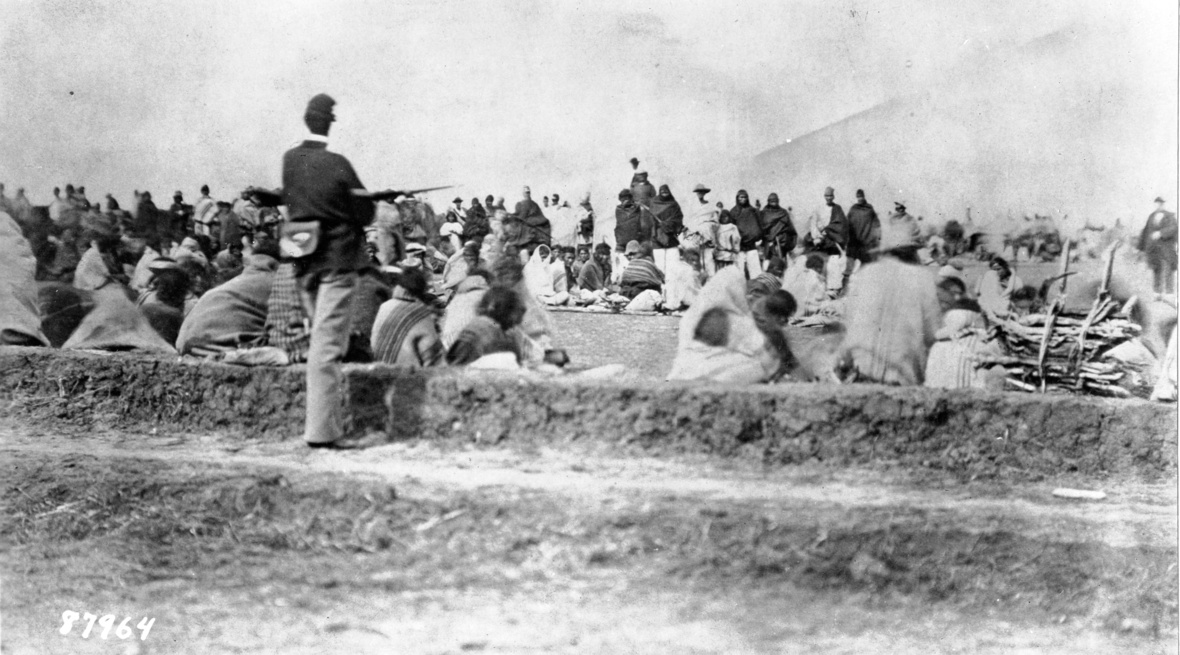
In 1866, having heard about the probable need for cattle at Fort Sumner, New Mexico/ They hoped that demand for beef from settlers, soldiers stationed at military outposts across New Mexico, and Navajos recently placed on reservations near Fort Sumner would make the drive profitable. With 18 cowpunchers, they brought 2,000 head of cattle to Fort Sumner, New Mexico. Over 8,000 Navajo had been interned at the Bosque Redondo reservation under the control of the fort, but due to the poor conditions on the reservation for agriculture and inadequate planning by the US authorities for provisions, the demand for new food supplies became urgent (see picture below). Goodnight and Loving received $0.08/pound for the steers in the herd, although they were unable to interest the government agent in 800 stocker cattle. Goodnight returned to Texas with about $12,000 in gold to buy more cattle.
Their route later became known as the Goodnight-Loving Trail. The two cattlemen sold beef to the army for $12,000 in gold, and then Loving drove the stock cattle on to Colorado and sold them near Denver, while Goodnight returned to Weatherford, the seat of Parker County, Texas, with the gold and also for a second herd. The two men were reunited in southern New Mexico, where they went into partnership with John Chisum at his ranch in the Bosque Grande, about forty miles south of Fort Sumner. They spent the winter of 1866-67 there and supplied cattle from the ranch to Fort Sumner and Santa Fe.
In the spring of 1867, Loving and Goodnight returned to Texas, ready to start a new drive. This third drive was slowed by heavy rains and Native American threats. Loving went ahead of the herd for contract bidding, taking only Bill Wilson, a trusted scout, with him. Although he told Goodnight that he would travel at night through Native American Indian country, he pushed ahead during the day. In a Comanche attack, he was seriously wounded at the now-named Loving Bend on the Pecos River.
The weakened Loving sent Wilson back to the herd, eluded the Indians, and, with the aid of Mexican traders, reached Fort Sumner, only to die there of gangrene, when he refused amputation. Before he died on September 25, 1867,
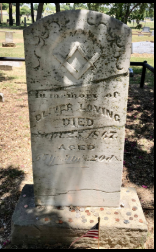
Goodnight assured him that his wish to be buried in Texas would be carried out. After a temporary burial at Fort Sumner, while Goodnight drove the herd on to Colorado, Goodnight had Loving’s body exhumed and returned to Texas. Stories differ as to who accompanied the body back to Weatherford, but he was reburied there in Greenwood Cemetery on March 4, 1868 (see below).

ANCESTRY- TEDDY’S GREATEST SACRIFICE
 ANCESTRY- TEDDY’S GREATEST SACRIFICE
At least 19 U.S. presidents have had children (Jefferson, JQ Adams, Jackson, Van Buren, W. H. Harrison, Tyler, Taylor, Lincoln, A. Johnson, Grant, Hayes, B. Harrison, Cleveland, T. Roosevelt, Taft, F. Roosevelt, Eisenhower, G.H.W. Bush, and Biden) who served in the military during a time of war. This tradition stretches from the Revolutionary War to the post-9/11 conflicts in Iraq and Afghanistan.
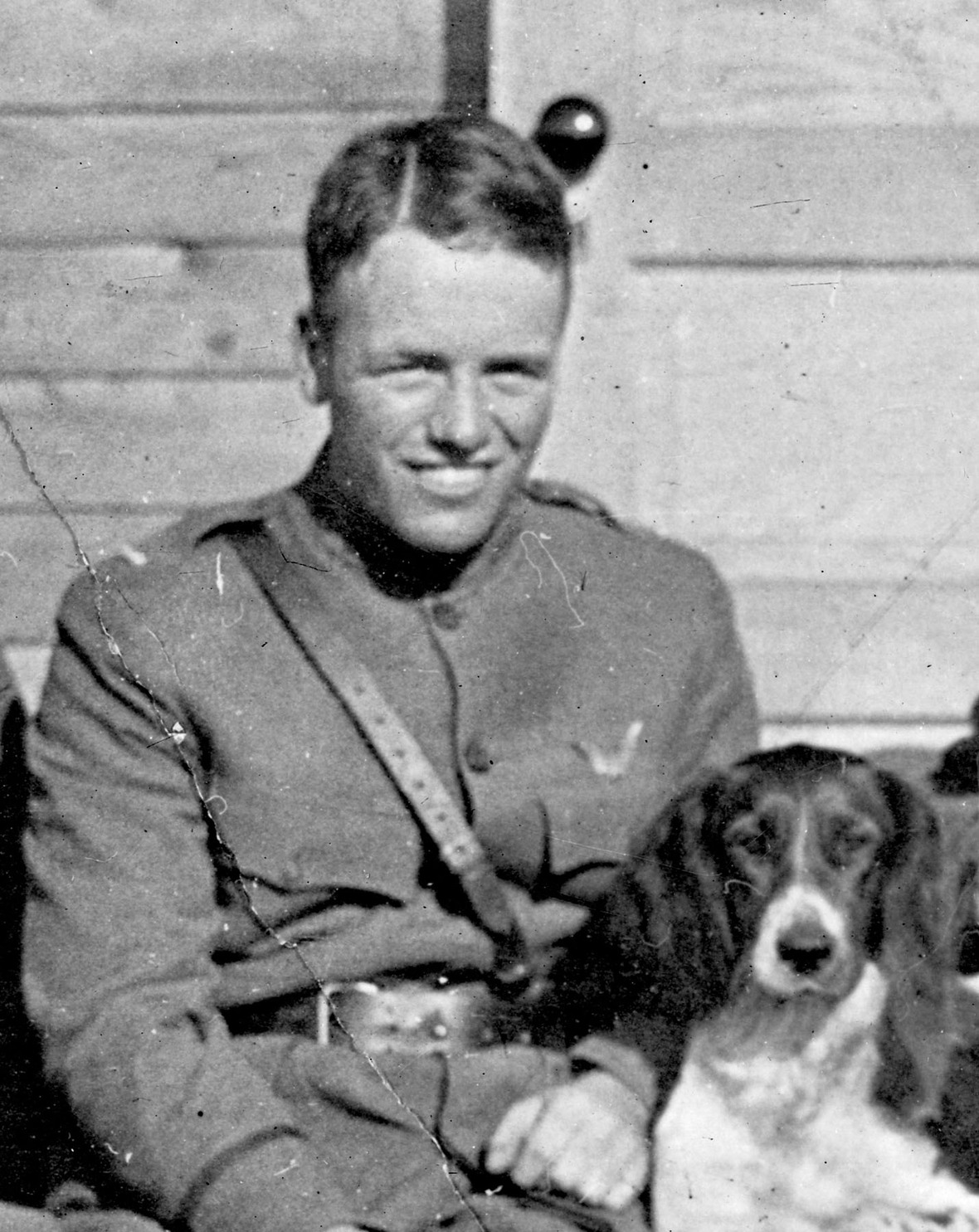
We learned at the Theodore Roosevelt Presidential Library that all four of his sons volunteered for World War I. His youngest son, Quentin Roosevelt (pictured above), was a pilot who was shot down and killed in action over France in 1918.
Quentin had become a pilot in the 95th Aero Squadron, part of the 1st Pursuit Group. Roosevelt had one confirmed kill of a German aircraft during the German spring offensive, which he shot down on July 10, 1918. Four days later, in a massive aerial engagement at the commencement of the Second Battle of the Marne, he was himself shot down behind German lines.
Captain Eddie Rickenbacker, commander of the 94th Aero Squadron (also known as the “Hat-in-the-Ring” Squadron), in his memoirs described Roosevelt’s character as a soldier and pilot in the following words:
As President Roosevelt’s son, he had rather a difficult task to fit himself in with the democratic style of living which is necessary in the intimate life of an aviation camp. Every one who met him for the first time expected him to have the airs and superciliousness of a spoiled boy. This notion was quickly lost after the first glimpse one had of Quentin. Gay, hearty and absolutely square in everything he said or did, Quentin Roosevelt was one of the most popular fellows in the group. We loved him purely for his own natural self.
He was reckless to such a degree that his commanding officers had to caution him repeatedly about the senselessness of his lack of caution. His bravery was so notorious that we all knew he would either achieve some great spectacular success or be killed in the attempt. Even the pilots in his own flight would beg him to conserve himself and wait for a fair opportunity for a victory. But Quentin would merely laugh away all serious advice.
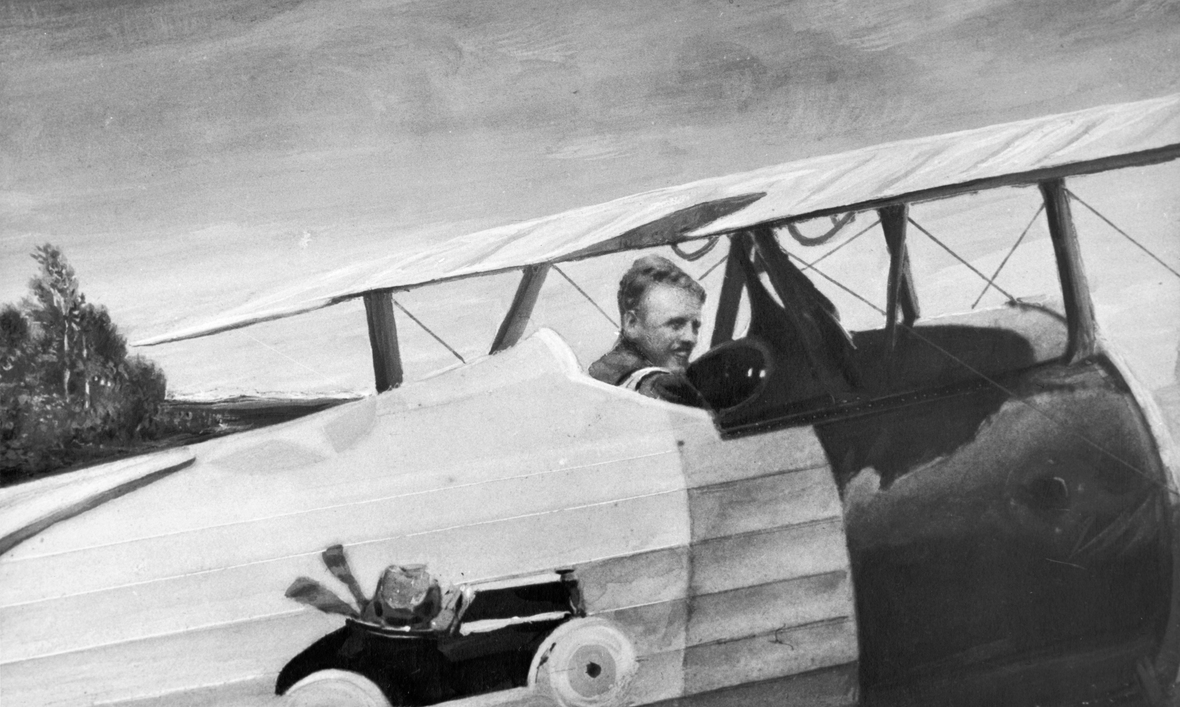
Quentin’s plane, a Nieuport 28 (pictured below with him at the contols) was shot down in aerial combat over Chamery, a hamlet of Coulonges-en-Tardenois (now Coulonges-Cohan).
He was killed by two machine gun bullets which struck him in the head. The German military buried him with full battlefield honors. Since the plane had crashed so near the front lines, they used two pieces of basswood saplings, bound together with wire from his Nieuport, to fashion a cross for his grave. For propaganda purposes, they made a postcard of the dead pilot and his plane. However, this was met with shock in Germany, which still held Theodore Roosevelt in high respect and was impressed that a former president’s son died on active duty.
ANCESTRY- PAPA, THE PIRATE PRESIDENT
 ANCESTRY- PAPA, THE PIRATE PRESIDENT
In the last edition, I covered my pirate ancestor Jan Janszoon.
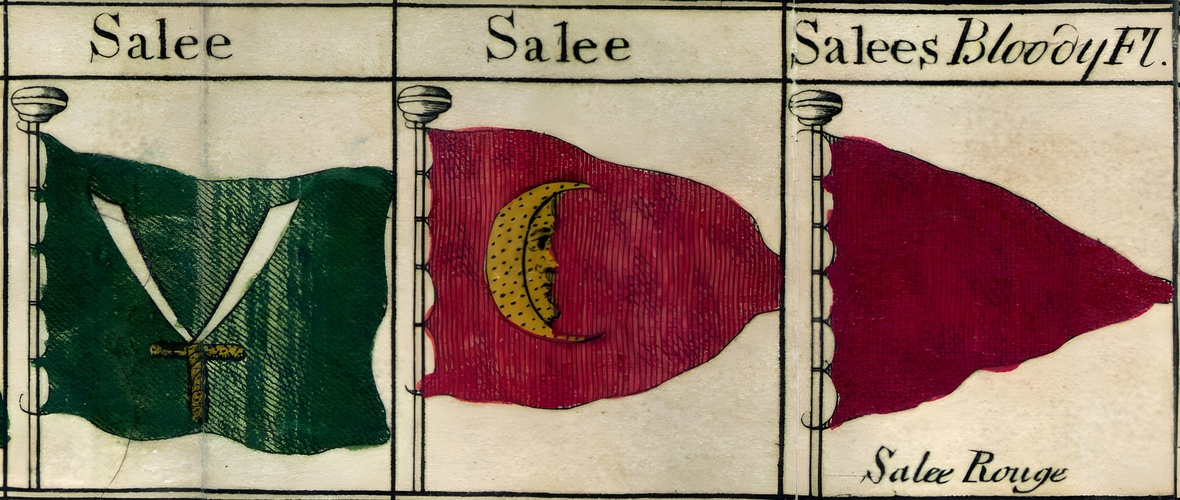
In 1619, the Salé Rovers (a group of Barbary pirates) declared the port of Salé an independent republic free from the Sultan of Morocco. They set up a government that consisted of 14 pirate leaders and elected Janszoon as their President. He also served as the Grand Admiral, known as Murat Reis, of their navy. The Salé fleet totaled about eighteen ships, all small because of the very shallow harbor entrance.
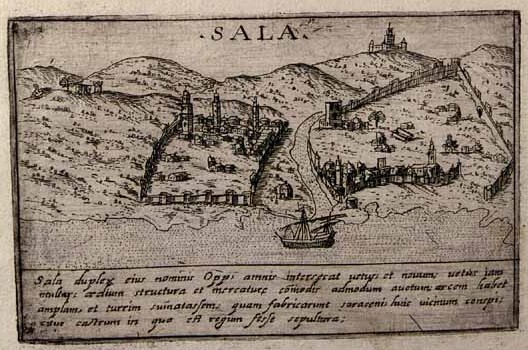
After an unsuccessful siege of the city, the Sultan of Morocco acknowledged its semi-autonomy. Contrary to popular belief, Sultan Zidan Abu Maali did not reclaim sovereignty over Salé (see picture above of Salé in the 1600s) and appoint Janszoon as governor in 1624; rather, he acknowledged Janszoon’s election as president by formally appointing him as his ceremonial governor.
Under Janszoon’s leadership, business in Salé thrived. The main sources of income of this republic remained piracy and its by-trades, shipping and dealing in stolen property. Historians have noted Janszoon’s intelligence and bravery, which were evident in his leadership. He was forced to find an assistant to keep up, and hired a fellow countryman from the Netherlands, Mathys van Bostel Oosterlinck, who served as his Vice-Admiral.
Janszoon became very wealthy from his income as pirate admiral, payments for anchorage and other harbor dues, and the brokerage of stolen goods. The political climate in Salé worsened toward the end of 1627, so Janszoon moved his family and his entire operation back to semi-independent Algiers.
Janszoon became bored by his new official duties from time to time and again sailed away on a pirate adventure. In 1622, Janszoon and his crews sailed into the English Channel with no particular plan but to try their luck there. When they ran low on supplies, they docked at the port of Veere, Zeeland, under the Moroccan flag, claiming diplomatic privileges based on his official role as Admiral of Morocco (a very loose term in the context of North African politics).
The Dutch authorities could not deny the two ships access to Veere because several peace treaties and trade agreements were in effect between the Sultan of Morocco and the Dutch Republic at the time. During Janszoon’s anchorage there, the Dutch authorities brought his Dutch first wife and children to the port to try to persuade him to give up piracy. Such strategies utterly failed with the man.
While in Morocco, Janszoon worked to secure the release of Dutch captives from other pirates and prevent them from being sold into slavery. Janszoon was fluent in several languages, and while in Algiers he contributed to the establishment of the Franco-Moroccan Treaty of 1631 between French King Louis XIII and Sultan Abu Marwan Abd al-Malik II
In 1627, Janszoon captured the island of Lundy in the Bristol Channel and held it for five years, using it as a base for raiding expeditions. The Barbary pirates, under his command, flew an Ottoman flag over the island. Slaving raids were made from Lundy by the Barbary pirates, and captured Europeans were held on Lundy before being sent to Algiers to be sold as slaves. More on his slaving raids in the next edition.
Janszoon’s name had morphed into recognition of his first base of power, Salé, so he became, in Dutch, Jan Van Salee, which was the surname that his sons Anthony and Abraham went by.
ANCESTRY- HARPS, HEAVY METAL, AND HYPER-IDENTICAL DNA
 ANCESTRY- HARPS, HEAVY METAL, AND HYPER-IDENTICAL DNA
While attending the Estes Park Long Peak Scotsfest and Military Tattoo, we got to watch some fun musicians. One of them was two sets of twins, the Harp Twins and the Volfgang Twins. They are both sets of identical twins. The Harp Twins, Twins have been at it longer, but somewhere along the way they met the death-metal Volfgang Twins (Dromil and Dromal), started performing together, and, after several years, married (termed a quaternary marriage). Twin researchers estimate that only about 300 such marriages have ever occurred worldwide.
In the picture below, you can see that one of my friends used AI to change my outfit from shorts and a T-shirt to a proper Scotsman’s outfit. I actually met the Volfgangs first at the back entrance to the performance and asked that stupid question that goes through every guy’s brain. Do you ever worry about drinking too much one evening and confusing your wife and your sister-in-law? Their answer was “we don’t drink!” Good idea!
I was curious, but thankfully ran out of time to ask them, “When one of the couples fell in love, did the other couple do the same just as easily, due to identical DNA and pheromones?”
The scientific answer is that because identical twins share the same DNA, their MHC MHC determined baseline odor is virtually indistinguishable to humans. In famous “sweaty T-shirt studies”, strangers cannot tell the difference between the scent of identical twins. Human testers often mistake two duplicate shirts from the same person as belonging to two identical twins.
I asked one of the Harp twins if they’d ever taken a DNA test, and she said she never would, as Dr. Phil has identical twins who took tests with the major testing companies and got completely different results.
Actually, Dr. Phil doesn’t have identical twins. His oldest son married an identical triplet, and they took 23andMe tests, which revealed ethnic differences that caused some excitement. 23andMe responded as follows: They noted that their system uses different analytical thresholds (ranging from a strict “conservative” 90% confidence level to a loose “speculative” 50% confidence level). At a looser, more speculative level, the software is essentially forced to guess or choose among highly similar geographic regions when reading a person’s raw DNA data. So, whatever that means.
While we’ve all heard that Twins run in families, it’s not always the case; for example, when a set of identical twin brothers has children with a set of identical twin sisters, their odds of having twins of any type are the same as any other couple. However, because the children born to the separate couples are legally first cousins, even though both sets of parents share completely identical DNA pools, the children are genetically full siblings.
ANCESTRY- THE PIONEER MINER WHO WAS IN TWO PLACES AT ONCE
 ANCESTRY- THE PIONEER MINER WHO WAS IN TWO PLACES AT ONCE
One of my mother-in-law’s immigrant ancestors was Joseph Needham, whom I wrote about his Civil War sufferings last September Joseph
Joseph had a brother, John, born in 1819, who also came to the US and must have gained experience in England as a miner, as he went to Columbiana, Ohio, while Joseph went to Michigan. In Ohio, he worked as a coal miner.
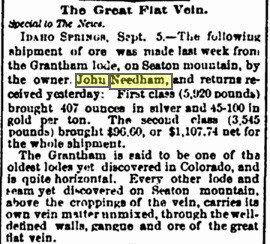
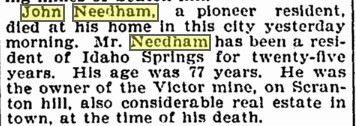
He is recorded in the newspaper articles above and below as a ‘59er (in Colorado for the 1859 Gold and Silver boom), but he must have got there a little later, since he was recorded in OH in the July 1860 census, or the household thought he was en route and added him to the count.
This entry in the town’s history indicates that in the summer of 1860, a formal survey and platting of Grass Valley (which comprises a large portion of modern-day Idaho Springs) was conducted. Historic gazetteers list John Needham as one of the recognized civil authorities and prominent property leaders during the pre-county-organization period. His real estate holdings, as noted in the article, were tied directly to these foundational town lots.
It would have taken at least 12 days by rail, boat, and stagecoach to reach Idaho Springs from OH, so theoretically he could have been in both places in the summer of 1860, but more likely it would have taken as much as 7 weeks.
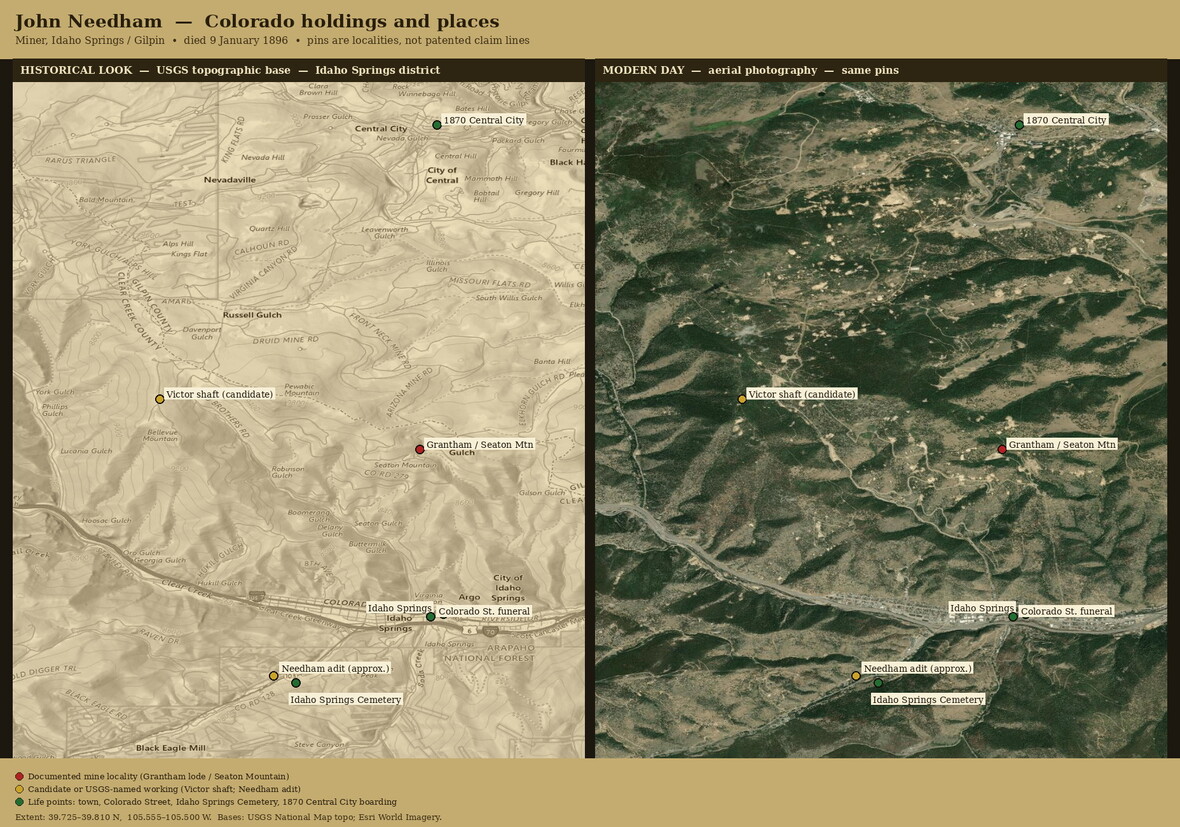
The second article highlights his shipment of high-grade ore from the Grantham lode on Seaton Mountain. He didn’t just operate there; he was fully integrated into the mountain’s grid’s early development. He worked alongside iconic district operators like J.K. Womack (one of the principal owners of the original Seaton lode) and P.E. Charruand to establish the core network of horizontal “flat veins” that became the backbone of Idaho Springs’ silver and gold boom. [
He appears in the 1870 and 1880 censuses as a miner and mine owner in Idaho Springs, Clear Creek, Colorado, where he died on January 8, 1896.
Below is a map of his significant high-producing mines and the Idaho Springs Cemetery, where he can gaze at I-70 in the canyon for eternity.
ANCESTRY- THE FIRST STREAMERS
 ANCESTRY- THE FIRST STREAMERS
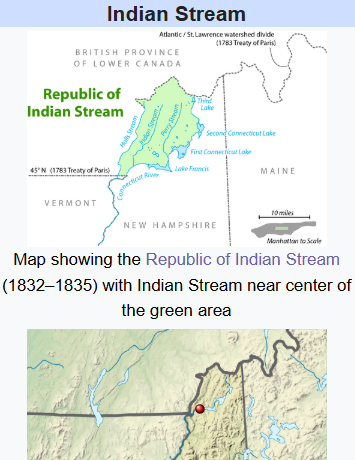
For several remarkable years in the 1830s, a small community along the present-day New Hampshire–Quebec border effectively became its own country.
The dispute originated with the 1783 Treaty of Paris, which left the northern boundary of New Hampshire unclear because of conflicting interpretations of the “northwesternmost head” of the Connecticut River. Both the United States and British Canada claimed the territory, and residents sometimes faced competing tax collectors and officials from both governments.
Frustrated by the uncertainty, approximately 300 residents declared themselves the Republic of Indian Stream on July 9, 1832. They adopted a constitution, elected their own government, and declared themselves a “free, sovereign and independent state” until the international boundary could be settled.
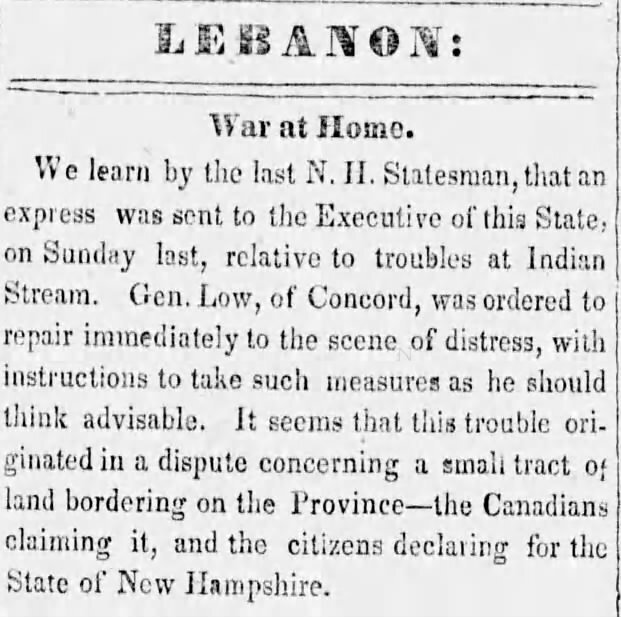
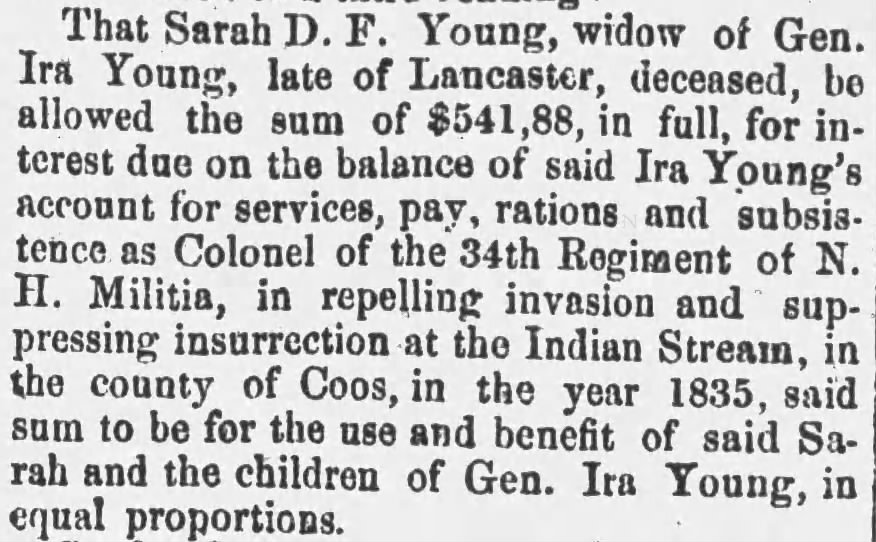
The experiment did not last long. In 1835, mounting pressure from New Hampshire, including the threat of militia intervention, led most residents to accept New Hampshire authority. Tensions with Canadian officials continued, however, and one dispute over an unpaid hardware-store debt escalated into arrests, an armed confrontation, and a diplomatic protest to President Andrew Jackson.
By 1840, the territory had become Pittsburg, New Hampshire.
The international boundary was finally settled by the Webster–Ashburton Treaty of 1842, confirming the former republic as part of New Hampshire (see adjacent map).
For a brief period, however, this remote corner of New England had its own constitution, elected government, and claim to independence—one of the strangest little republics in American history.
ANCESTRY- PRESERVE YOUR FAMILY HISTORY, TODAY
 ANCESTRY- PRESERVE YOUR FAMILY HISTORY, TODAY
Reach out to Dancestors Genealogy. Our genealogists research, discover, and preserve your family history so those stories don’t disappear. Ancestry only gets tougher as time diminishes recall.
No one is getting any younger, and memories fade every year, eventually slipping beyond our ability to recover them. Paper gets thrown in the trash; books survive.
We offer:
Ready to embark on your family history journey?
Call Dan Nelson at 214-914-3598 and get your project started today.
