

05 Sep Genealogy- Newsletter- September 5, 2026
GENEALOGY- THE NEWSLETTER PODCAST STYLE!
You can now listen as well as read the Dancestors Genealogy Newsletter.
Listen to all Dancestors Genealogy newsletters on our podcast page.
PODCASTS
 THE SEA CAPTAIN AND MY 11TH GREAT GRANDFATHER’S TRIAL AND HIS GRANDSON THE GRUMBLER
 THE SEA CAPTAIN AND MY 11TH GREAT GRANDFATHER’S TRIAL AND HIS GRANDSON THE GRUMBLER
I am about 12% Swedish, with both of my father’s paternal grandparents being born in Sweden. I also plenty of distant Duthc ancestry, which includes a Dutch line that emigrated nine generations earlier from Borgholm, Öland Island, Sweden.
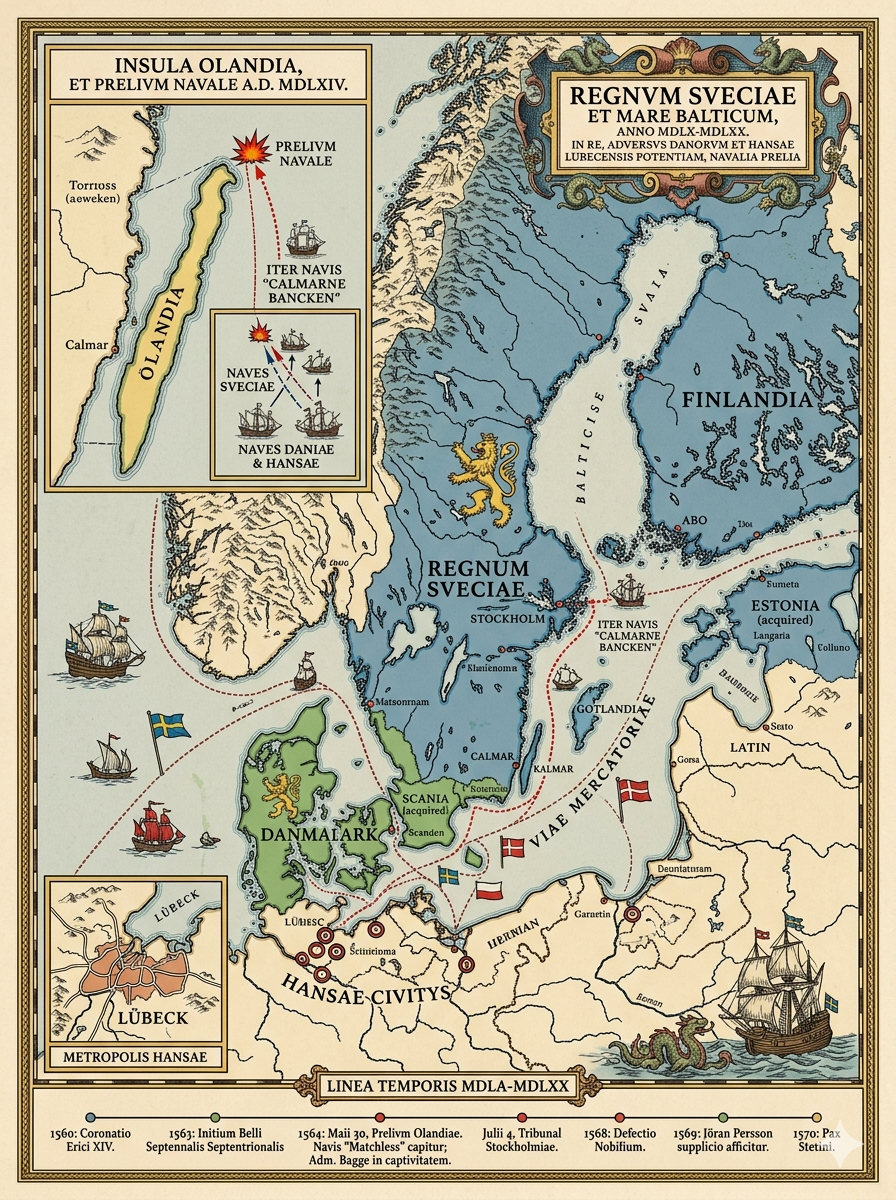
My 9th Great Grandfather, Claes Corneliszen Van Schouwen Claes, was born in 1597 in Boda, Kalmar, Sweden. Boda was at the northern tip of Öland, an island off the coast of Kalmar, Sweden (see the adjacent map).
Claes’ nickname was “Mutelaer” (Grumbler). Claes was only 2 when his father died in 1599, and in 1603 he was placed under the guardianship of his maternal grandfather, Jacob Van Der Goes of Walcheren, Holland, and Colmar, Sweden, and he learned the trade, which often took him by ship to the Dutch Islands. Claes married Jacob’s granddaughter Margaret Van der Goes on November 9, 1623, in the Netherlands.
In 1624, he returned to Boda, on the Island of Öland in Denmark (now Sweden), to introduce his new wife to his family. In December 1625, he owned a ship called the “Svenska Kronan”, and his home at this time was at Zierikzee, on the Island of Schouwen, in Holland.
The 30 years’ War caused him to sell his boats, and he came to New Amsterdam in 1636 and settled in Breukelen. He became the farm manager for Peter Stuyvesant (famous for the purchase of Manhattan) and was also a merchant and sea captain.
Claes’ father was Cornelius Pieterse Van Schouwen, and his father was Peter Ericksson Van Schouwen.
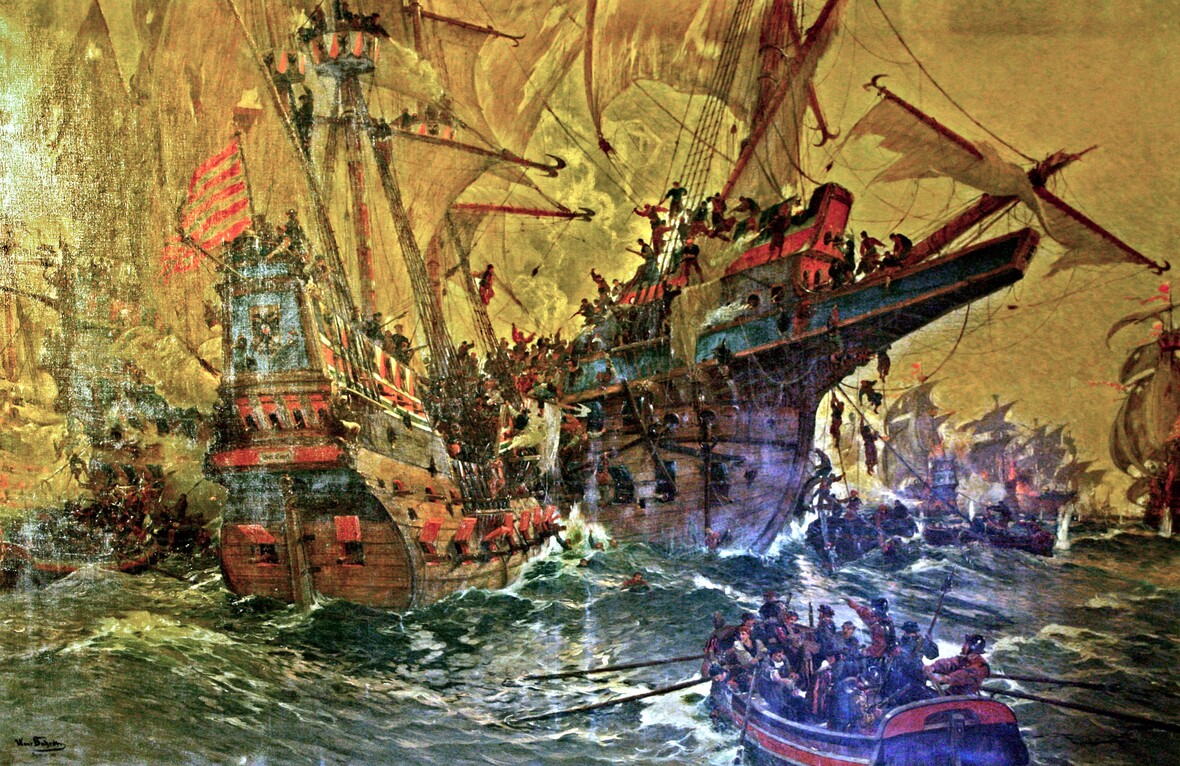
Peter was involved in the First Battle of Öland (pictured below), which was part of the Nordic Seven Years War (1563-1570), which broke out as a result of King Erik XIV of Sweden’s claim for dominion over the Baltic Sea, which “challenged the trade interests of both Denmark and the Hanseatic city of Lubeck”. It took place on 30–31 May 1564 between the islands of Gotland and Öland, off the northern tip of Öland, between a Dano-Lübeckian fleet of 36 ships, the Danes under Herluf Trolle and the Lübeckers under Friedrich Knebel, and a Swedish fleet of 38 ships under Admiral Jakob Bagge. It was a Dano-Lübeckian victory.
Peter and his brothers became famous or infamous for the actions in the battle as detailed below:
At a trial on July 4, 1564, a charge of cowardice against Swedish naval captains Hans, Nils, and Peter Eriksson failed. Several officers were condemned to death by the king’s jury and adviser Joran Person because captured prisoners had escaped. Hans Eriksson was among those condemned but received a pardon, only to be killed the next year in Upsala castle under suspicion of conspiracy.
Peter Eriksson was more fortunate and fought bravely in the Seven Years’ War of the North. Under Admiral Jacob Bagge, Peter commanded the Calmarne Bancken during a fierce battle against the Danish and Lubeck fleets. Even after a gale separated most ships and the flagship Matchless caught fire and surrendered, Peter continued fighting valiantly. He later commanded the Ornen, helping Sweden secure mastery of the Baltic.
Meanwhile, King Erik XIV ruled with increasing cruelty, aided by his ruthless adviser, Joran Person. The supreme court passed frequent death sentences, sparking a revolt by the nobles. In 1569, Stockholm was captured, Person was executed, and the king was forced to abdicate. After Person’s death, a hit list was found containing his intended victims. This roster included Peter Eriksson, his young son Cornelius, and the three sons of Captain Nils Eriksson—Marten, Hans, and Erik Nilsson—who had also been condemned to death.
Persons’ execution saved their lives, but Sweden remained highly unstable under the next ruler, Johan III. Many citizens fled the country for New Sweden and New Amsterdam. Back in Europe, Captain Peter engaged in a bitter legal dispute with a Dutch businessman, Jacob van der Goes. Despite the fierce hostility between their fathers, Peter’s son Cornelius and Jacob’s daughter Johanna fell in love and eventually got married. Which is good, or I wouldn’t be here!

THE PRESIDENT’S TONGUES
 THE PRESIDENT’S TONGUES
I recently read that President Herbert Hoover spoke Mandarin, and spoke it to his wife in the White House, so as not to be overheard by spies, which is sort of ironic, as the Chinese spies of today would have found that convenient.
The article got me wondering how many other presidents could speak a foreign language. The full rundown is below, but French was the clear winner, with six presidents speaking it fluently.
The other irony was that the presidents who led us through the two world wars with Germany both spoke fluent German. No, Kennedy’s “Ich bin ein Berliner”, does not count.
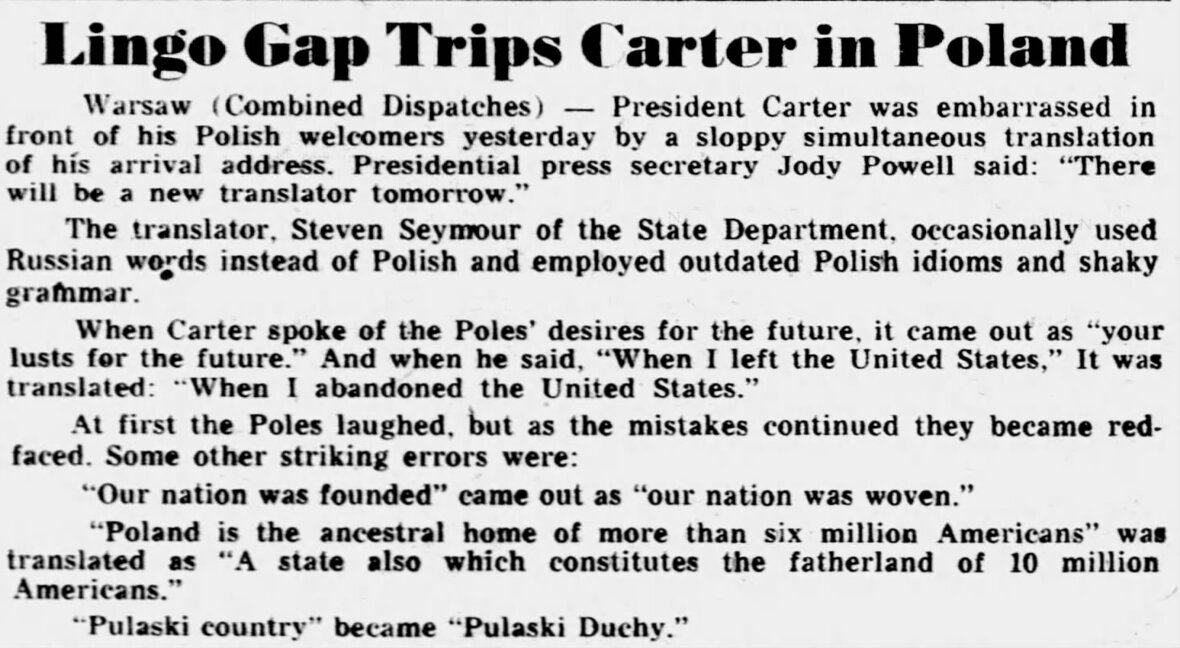
No doubt these 15 multi-lingual presidents used their skills to their advantage. There is a serious risk of letting someone else speak for you, as this story tells:
Hoping to build warm relations with the Polish public, President Jimmy Carter gave a standard goodwill speech. However, the State Department had hired a freelance interpreter who lacked professional experience translating state visits, resulting in several hilariously inappropriate blunders:
• Carter began his address with, “I left the United States this morning,” which the translator mangled into Polish as, “I left the United States, never to return.”
• Carter’s praise of the historic 1791 Polish Constitution was accidentally translated to imply that the document was open to ridicule.
• When Carter attempted to express his interest in learning about the Polish people’s “desires for the future,” the interpreter used a heavily sexualized word, translating it to the crowd as “your lusts for the future” and declaring that Carter “desired the Poles carnally.”
The story is ironic as several of our presidents have had to address their carnal desires, but this was an accidentally expressed carnal desire.
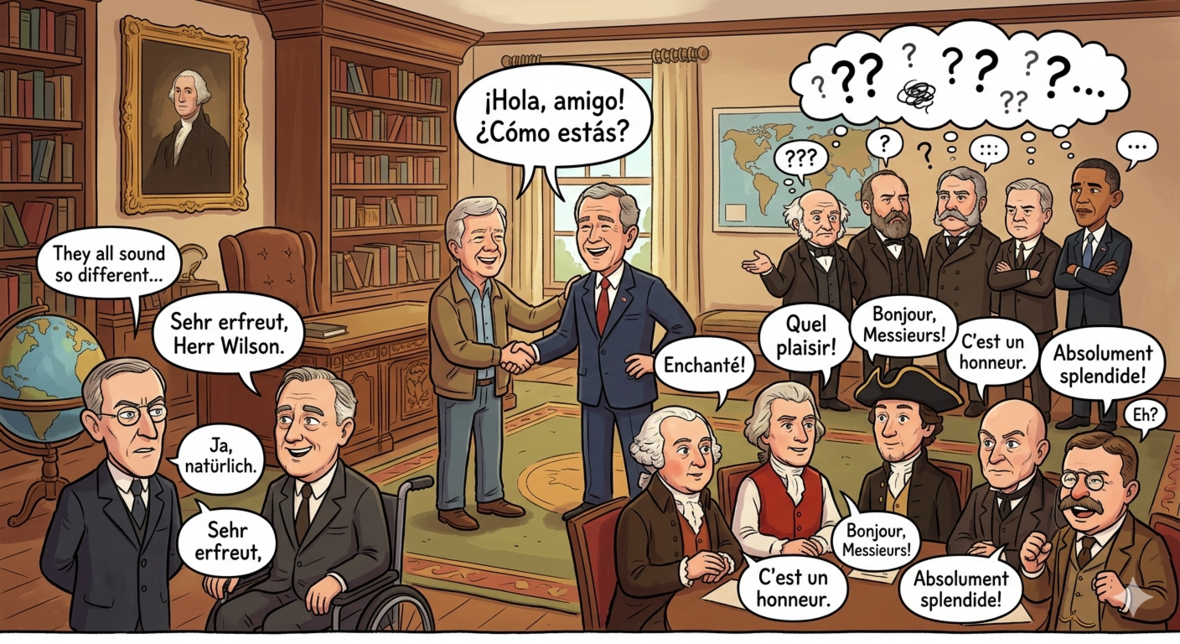
Here’s the breakdown by president, and below that a cartoon created to illustrate the afterlife conversation they’ll all have or not have:
• John Adams (2nd President)- Fully fluent in French for European diplomacy; classically trained in reading and writing Latin and Greek.
• Thomas Jefferson (3rd President)- Read and spoke French and Italian fluently. TJ taught himself Spanish and read classical literature in Greek and Latin.
• James Madison (4th President)- Scholar of ancient languages; studied and read biblical Hebrew extensively during his time at Princeton.
• James Monroe (5th President)- Achieved full fluency in French during his years serving as a diplomat and minister in Paris.
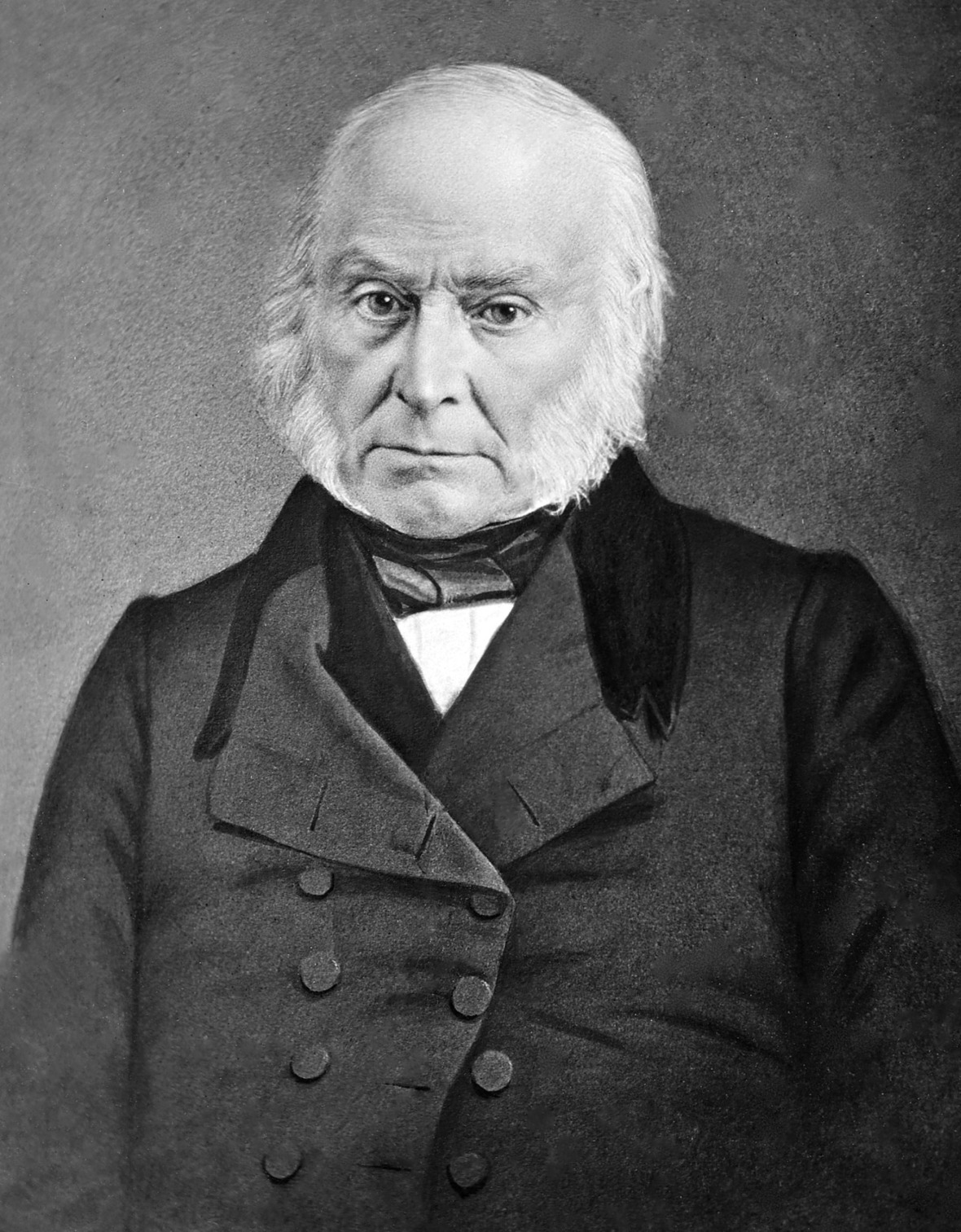
• John Quincy Adams (6th President)- The most multilingual president in history (pictured above in the oldest presidential photograph). JQA possessed native fluency in French, translated German and Dutch flawlessly, and learned Russian to speak directly with the Imperial Court.
• Martin Van Buren (8th President)- Native speaker. MVB grew up speaking Hudson River Dutch in New York, making him the only U.S. president to have spoken English as a second language.
• James A. Garfield (20th President)- Classical scholar and professor of ancient languages. JAG famously demonstrated his ambidexterity by simultaneously writing Latin with one hand and Greek with the other.
• Chester A. Arthur (21st President)- Classically trained; could read, write, and converse fluently with fellow scholars in Latin. Since he was Garfield’s VP you have to wonder did, they write to each other in Latin?
• Theodore Roosevelt (26th President)- Fluent in French and German, regularly consuming European literature and speaking both during foreign travels. Teddy was also conversational in Italian.
• Woodrow Wilson (28th President)- Read and spoke German proficiently.
• Herbert Hoover (31st President)- Conversational in Mandarin, which he learned while working as an engineer in China. He and his wife used it in the White House to prevent staff from overhearing private chats. HCH also translated complex Latin mining texts into English.
• Franklin D. Roosevelt (32nd President)- Gained native fluency in both French and German as a child through extensive travel and European tutors.
• Jimmy Carter (39th President)- Conversational speaker of Spanish. Jimmy studied it extensively, used it during Latin American diplomacy, and famously read a Spanish Bible nightly.
• George W. Bush (43rd President)- Conversational speaker of Spanish. GWB used his skills for regional political outreach in Texas and delivered parts of his presidential addresses in Spanish.
• Barack Obama (44th President)- Spoke Indonesian fluently as a young child while living, playing, and attending a local school in Jakarta, Indonesia.
UNEXPECTED FIRSTS IN THE FAMILY TREE
 UNEXPECTED FIRSTS IN THE FAMILY TREE
In the ongoing fantastical Anthony Van Salee saga, discussed in recent editions The Turk , I mentioned his brother Abraham. He was born between 1602 and 1609 in Cartagena, Murcia, Spain. He was a fellow New Netherland settler involved in privateering and described as a “mulatto” in recognition of his mixed-race ancestry. He married a black woman named Fortuyn.
Some descriptions of Abraham Janszoon van Salee include ethnic attributions, such as “Turk” and “Berber”. In court records, Abraham was noted as “Turk”, suggesting that record keepers classified him by appearance or culture. Abraham was known as the wealthy heir of a former European-born head of state. Researchers note that historical collections devoted to African-centric history have similarly been unable to reach consensus on his appearance, race, or origin. Abraham was a part-owner of the privateer La Garce. He died in April 1659 in New Amsterdam.
Abraham’s descendants included the following. His son Frans Abrahamszen van Salee (c. 1670s – after 1749), lived as a free man of color in New Amsterdam/New York and later moved his family to Tappan, New York/New Jersey. He married the widow, Isabella Solomons.
Franz’s son John (Jan) van Salee maintained the family landholdings in the Tappan and Ramapo regions along the New York-New Jersey border.
Jan’s son John Van Salee Jr. had a son John Van Salee III, who married a German immigrant, who had a daughter Maria van Salee (c. 1790s – 1800s). Maria married George de Grasse (an educated, property-owning free man of color who had immigrated to New York City and originally worked as a steward for Aaron Burr).
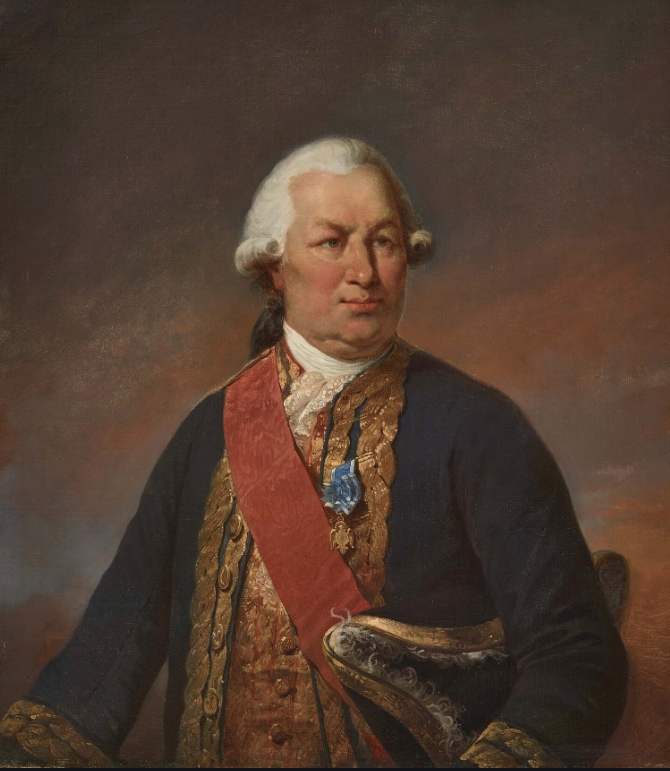
George deGrasse, was the presumed natural son of French admiral François Joseph Paul de Grasse and an Indian woman. George was born in Calcutta, India, about 1780 and originally named Azar Le Guen. Admiral De Grasse took Azar back to Paris for his education and adopted him, naming him George de Grasse.
Admiral De Grasse (pictured top right) is best known for his crucial victory over the Royal Navy at the Battle of the Chesapeake in 1781 during the American Revolutionary War. The battle directly led to the Franco-American victory at the siege of Yorktown and helped secure the independence of the United States.
George and Maria had children (my 6th cousins, 5 times removed):
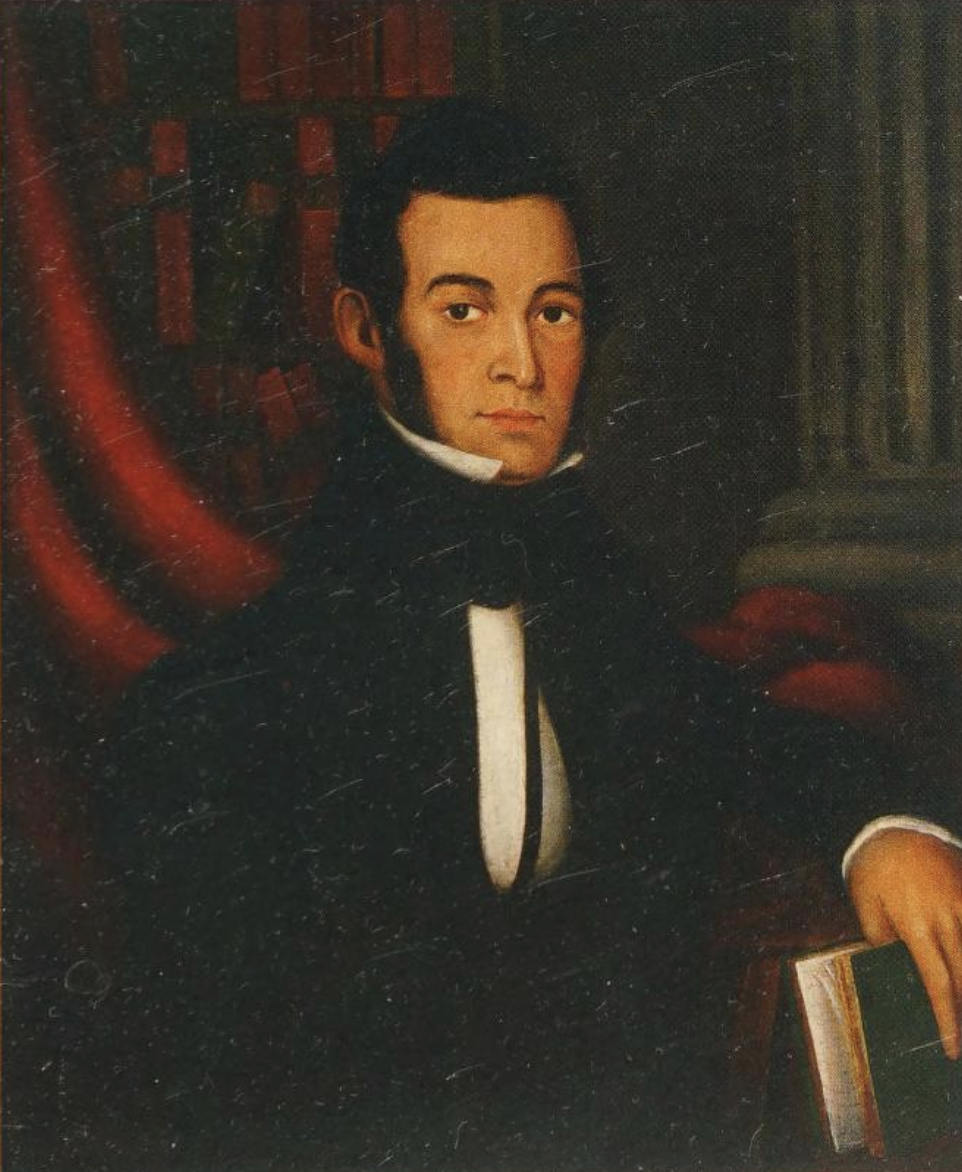
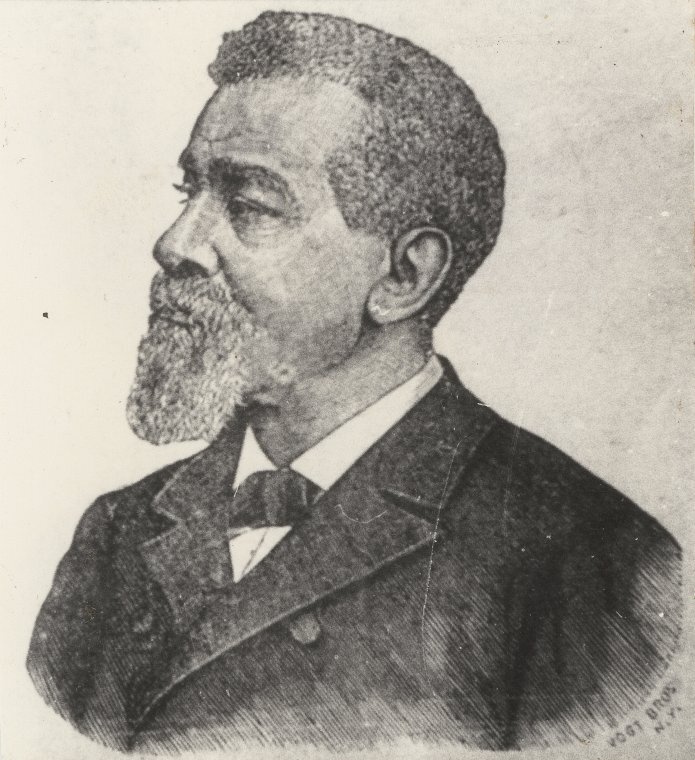
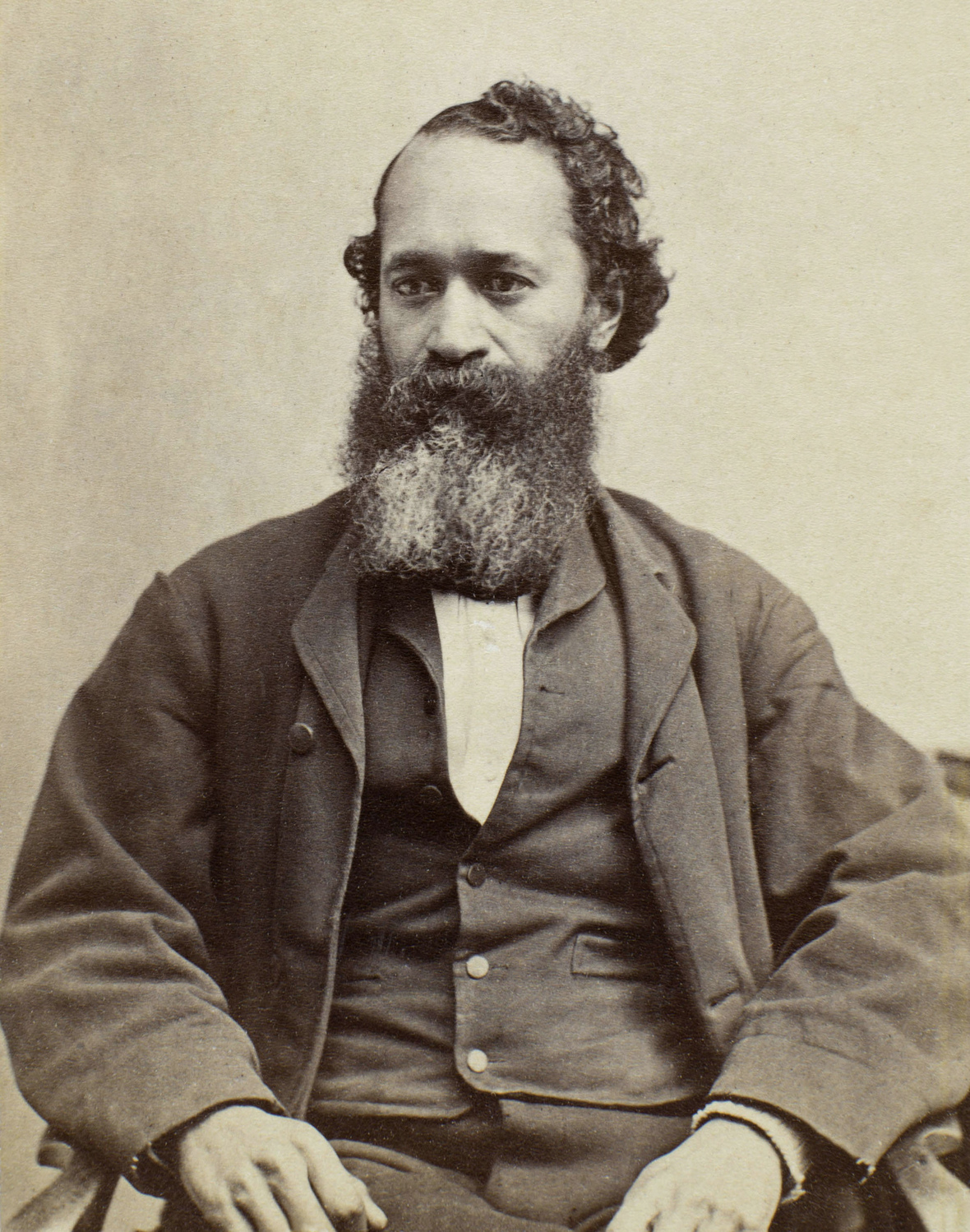
• Isaiah George DeGrasse (pictured below left) (1813 – 1841) was an American minister in the Protestant Episcopal Church. In 1836, he was the first African American to graduate from the University of Delaware. Isaiah’s complexion was comparatively fair and reportedly indistinguishable from the complexions of many white classmates.
• Serena Leonora DeGrasse attended Clinton Seminary in Oneida County, New York, where she met George Thomas Downing (pictured below center) (1819 – 1903), an abolitionist and an activist for African-American civil rights while building a successful career as a restaurateur in New York City; Newport, Rhode Island; and Washington, D.C. His father had been an oyster seller and caterer in Philadelphia and New York City, building a business that attracted wealthy white clients. From the 1830s until the end of slavery, Downing was active in the Underground Railroad, using his restaurant as a rest station for refugees on the move. He built a summer season business in Newport and made it his home. For more than 10 years, he worked to integrate Rhode Island public schools. During the American Civil War (1861–1865), Downing helped recruit African-American soldiers.
After the war, Downing moved to Washington, D.C., where for a dozen years he ran the Refectory for the House of Representatives. He was a prominent member of the Colored Conventions Movement and worked to unite the efforts of women’s rights and black rights movements. He became close to Senator Charles Sumner and was with the long-ailing legislator when he died of a heart attack at his home in Washington, D.C., on March 11, 1874.
• John van Salee de Grasse (pictured below right) (1825– 1868) was the first black medical doctor admitted to a United States medical society and a commissioned physician during the American Civil War. At fifteen, he enrolled in Oneida Institute in New York, later pursuing medical studies at Aubuk College in Paris. John earned his medical degree with honors from Bowdoin College’s Medical School of Maine in May 1849, becoming the second African American to do so in the United States. Following graduation, he practiced medicine in Paris alongside renowned surgeon Alfred A.L.M. Velpeau before returning to the U.S. in 1851. He supported abolitionism and efforts to resist the Fugitive Slave Act of 1850 by aiding in organizing vigilante groups to oppose slave hunters in Boston. In 1863, John served as an assistant surgeon with the 35th United States Colored Infantry Regiment. During the American Civil War, John served in the Union Army as a surgeon with the 54th Massachusetts Infantry Regiment, the first unit formed of the United States Colored Troops.
THE FARM ON THE HILL
 THE FARM ON THE HILL
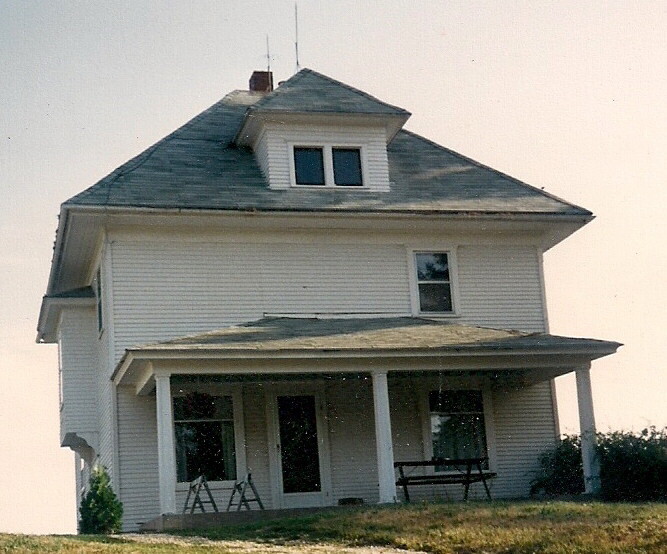
To get to my grandparent’s farm, you head from Lisbon, IA (where my grandparents moved from the farm) to Martelle, IA. When you get to the center of town, you take the highway to the right and drive several miles to the end of the road, where it says to turn right to Morley, and you head left. As you head up the hill, look to the right, and you’ll see the house and the barns up on the hill.
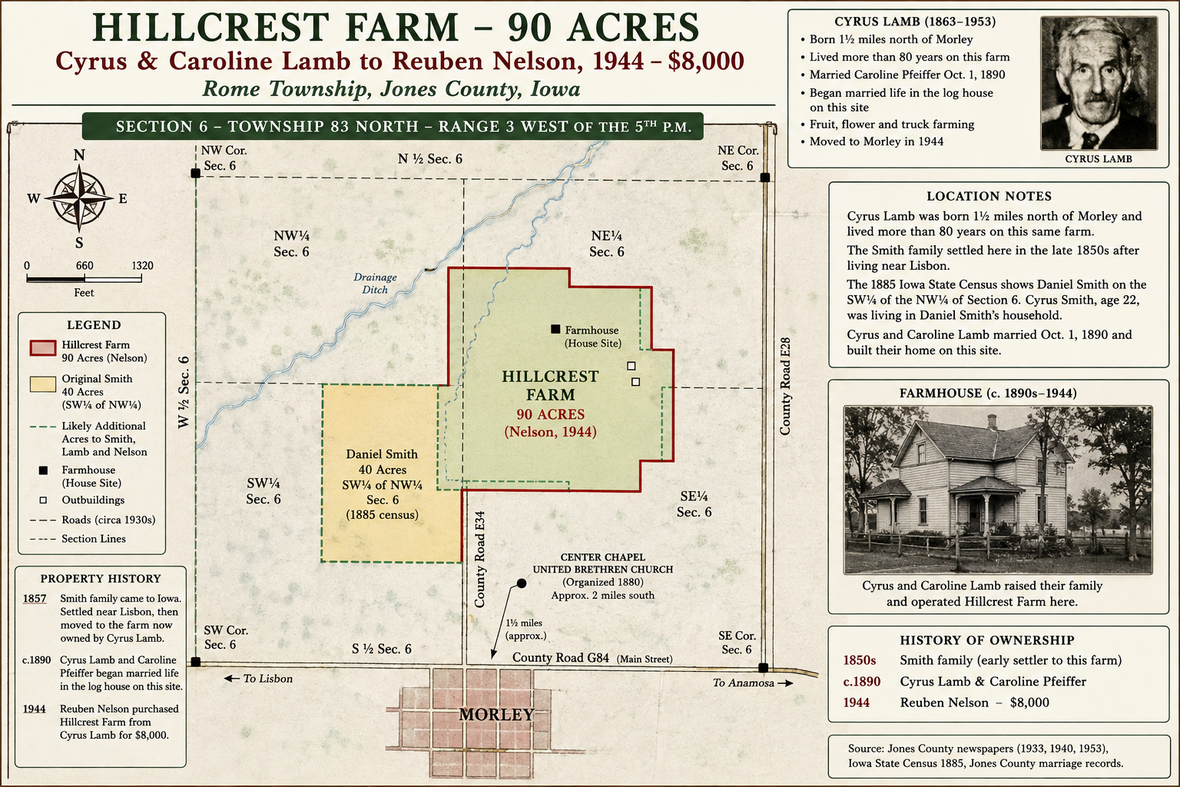
I visited in 2015, and the home and farm (see Hillcrest farm plate below) had been turned into a something resembling a defunct yard sale, junkyard, and trash heap, with signs reading “keep away ” to deter thieves. There were several abandoned vehicles on the property. The barns were falling down, as the owner already had his own farm buildings when he bought the farm. Overall, it was a sad sight.
This time we visited, and I got lost because I looked to the right and didn’t see the house and the barns up on the hill. So, eventually, I stopped and talked to a lady mowing her lawn, and while I was talking to her, I recalled that they had sold the farm to a neighbor, Jack Switzer. The nice lady said that the Switzer house had burned down about 5 years ago, but Ruth Switzer still lived down the road where the “Y” split. She said she was about 90, but still sharp.
We drove down the road and found Ruth’s house. She answered the door when I told her I was the Nelson grandson, and I explained that I was trying to find the farm. She said “just turn around, look down the hill, and that’s the farm.” They had bought the farm because it was so convenient to their home and farm. I asked how to get to the house and barns, and she explained that the house had burned about 5 years ago, which is what the mower lady was referring to and was calling it the Switzer house, because they owned the farm.
Ruth told me that her youngest son was living in the house, but he was at her house when the fire happened. The son died sometime after that, but it was not related to the fire.
Later, I met the oldest son, who was over mowing his mom’s lawn, and he said, out of earshot of his mother, that the younger brother had been nothing but trouble and sort of implied the fire was likely caused by his brother’s antics.
When we told him we were going to drive down to the barns to take some pictures, he was embarrassed by the property’s condition. Had we not known that the Switzer farm was just around the corner, we would have driven by it. Only the barn was barely visible by the metal roof and it’s pass-through elevated drive; the windmill still stood, and one outbuilding by the road.
Everything was overgrown, so there wasn’t anything to see, but, ironically, we could faintly make out an Airstream trailer parked in the barnyard (it was ironic since my parents towed one around the country). A sad finish to what was once a beautiful functioning farm.
THE ROYAL NAVY SAILOR AND NEW JERSEY PIONEER
 THE ROYAL NAVY SAILOR AND NEW JERSEY PIONEER
Richard Stout was born on April 2, 1615, in Nottinghamshire, England. According to lore, a teenage Richard fell in love with a young woman whom his father deemed far beneath their family’s social standing.
In protest of being denied, Richard ran away from home and joined the English Royal Navy. He served a grueling seven-year term aboard a British warship. When his seven years expired around 1640, his ship happened to be docked at New Amsterdam (modern-day Manhattan). Richard walked off the vessel, took an oath of allegiance to the Dutch to become a mercenary fighter, and permanently stayed in the New World.
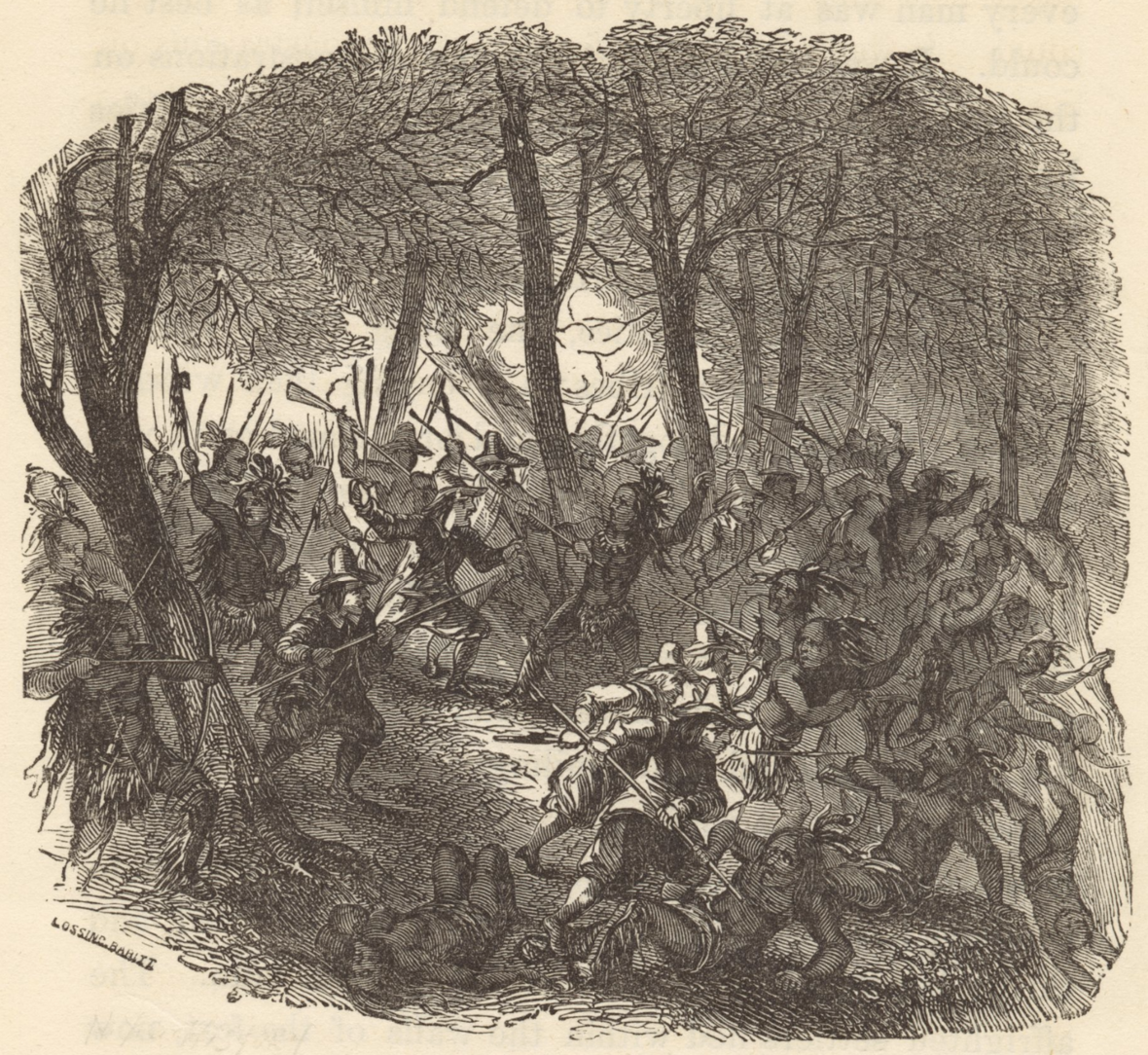
Records show that Stout was impressed into military service defending Fort Amsterdam that spring during fighting that “jeopardized the very existence of the Dutch settlements.” Known as Kieft’s War (Kieft and his massacre pictured below), the violence began on 25 February when Dutch Governor Willem Kieft ordered simultaneous massacres of the Weckquaesgeek in Corlears Hook (Manhattan) and the Tappan (Lenape) in Pavonia (now Jersey City), killing 120 native women, men, and children.
Richard later became one of the original 39 patentees who founded the town of Gravesend, Long Island (now Brooklyn) under Lady Deborah Moody. In June 1643, Moody founded the English village of Gravesend on what was then Dutch Long Island, seeking religious tolerance that was denied her in Puritan New England. Moody, like the Stouts, was Baptist. Stout was in Gravesend by 13 October 1643, when he made a statement about the theft of 200 pumpkins, which we shared a couple of editions ago: Pumpkins
It was here that Richard met and married Penelope. The Stouts’ later 1675 land claim suggests their oldest child was probably born in 1644-5, making it likely the couple married in 1643-4. Penelope had a fantastical origin story of her own, which will be shared in the next edition.
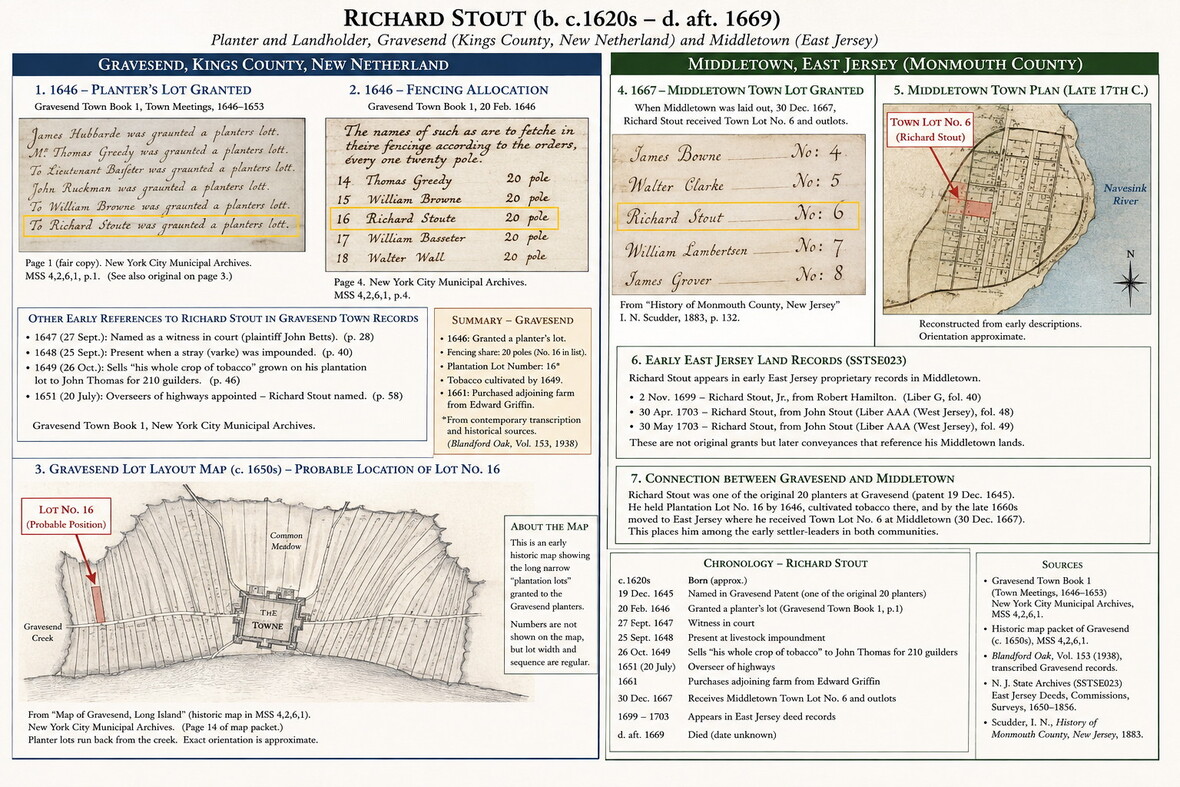
In Gravesend, he received plantation lot sixteen in the first allotment of house lots and farms on 20 February 1646. You can see the map of the town lot on the plate pictured below. Eight months later, on 26 October 1646, he sold his tobacco crop. In 1657, he had seventeen of his twenty acres under cultivation, and on 5 April 1661, he bought the adjoining plantation.
In early December 1663, a party of Gravesend settlers traveled up the Raritan River, prospecting for land. No progress was made until after the English won control of New Netherland in 1664. The Stouts permanently settled in New Jersey in 1664.
The 7 April 1665 Monmouth Patent identifies him as one of twelve men who bought land from the Lenape. In 1675, Stout reported the land he was due: “Richard Stout brings for his rights, for the year 1665, for his wife, two sons, John and Richard, 120 acres each; total 480 acres.” He obtained an additional sixty acres each for five children, James, Peter, Mary, Alice, and Sarah, bringing his total claim to 780 acres. Three additional children brought the total to ten, but Jonathan, Benjamin, and David “were evidently under the age of 14 in 1675,” or they would have been entitled to thirty acres each. These lots marked the official founding of the town of Middletown, and you can see Richard’s town lot in Middletown in the plate below.
Despite illiteracy, Richard Stout was “frequently elected to fill responsible positions in the conduct of the town’s public business.” He was an Overseer of Highways and a member of the Constables Court. On 26 Feb 1679-80, “Richard and Penelope Stout” sold a house, barn, orchard, and acreage. In 1686, Richard Stout owned 460 acres and produced 20 bushels of wheat and 26 bushels of Indian corn but received a tax abatement because he was “very old.”
Richard and Penelope Stout opened their family home, meeting with neighbors directly in the Stout kitchen to formally organize the very first Baptist congregation in the colony of New Jersey. When the congregation officially formalized its charter, Richard Stout and his oldest son, John, were among the 18 male charter members who signed the covenant. For the first twenty years of the church’s existence, members traveled through the wilderness each Sunday to rotate services between various family living spaces and kitchens.
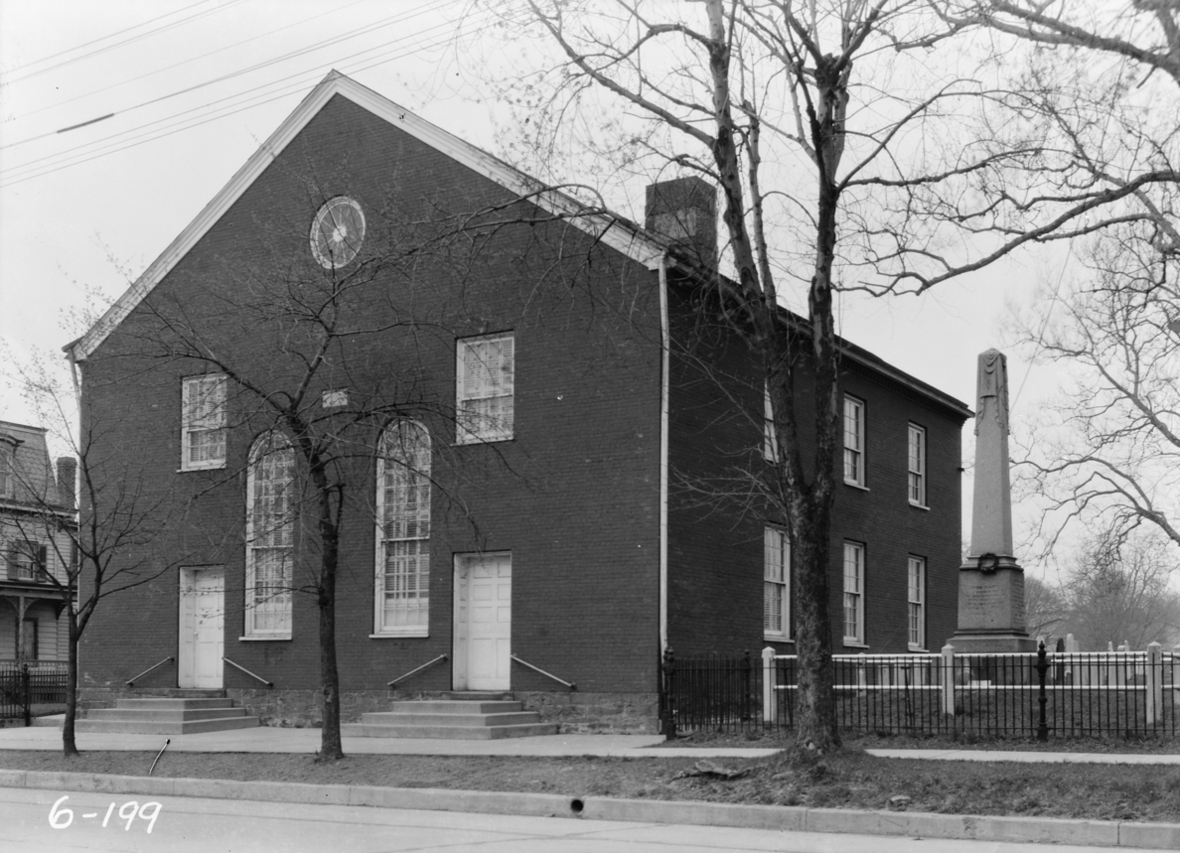
By 1688, the congregation had expanded far beyond what a private kitchen could hold. The pioneers constructed a simple log meetinghouse in Middletown, marking the first purpose-built house of Baptist worship in the state. You can see a picture of the successor church building above from almost 100 years ago.
Stout wrote his will on 9 June 1703, leaving his (unnamed) “loving wife” his orchard and “that part of or room of the house she now lives in with the cellar and all the land I now Improve,” as well as his horses, excepting a mare and colt, which he left to son Benjamin, as thanks for wintering his cattle the previous year (spelling modernized). The will names nine of the Stout children. Son Peter alone predeceased his parents. Richard Stout died before 6 October 1705, when the inventory of his estate was recorded and valued at £64.8.0. The abstract reports it contained “mostly hogs, cattle, horses and sheep.”
Modern readers often look at the lines giving their sons only “one shilling” and assume Richard disowned them. In colonial law, this meant the exact opposite. It was legal proof that he had already gifted them their massive land inheritance through “deeds of gift” while he was alive. Giving them one shilling in the final will protected the estate, preventing the older sons from legally contesting the will to take land away from the youngest son, Benjamin.
Richard legally protected Penelope by ensuring she retained total control over the home, barns, orchards, and livestock for the rest of her life, ensuring her financial independence as a widow.
Penelope passed away around 1712. A 1765 chronicle famously estimated that by the time she died, she had lived to see a staggering 502 living descendants, earning her the legendary historical title of the “First Lady of Monmouth.” More on her in the next edition.
THE CHARMS OF IOWA
 THE CHARMS OF IOWA
On the way to and from my above-mentioned grandparent’s farm, we visited a couple of places that were fun. In Winterset, IA, which is in Madison County, as in the Bridges of Madison County, we visited the John Wayne Birthplace Museum.
I had a couple of coincidental crossing of paths with the “Duke” (which we learned was his dogs name), when I was in the Boy Scouts, we would go down to the Sea Scout Base in Newport Beach, where we would practice our canoeing skills for our annual Thanksgiving canoe trip on the Colorado River. One of the fun things to do was pull up to John Wayne’s Newport Beach home’s launch ramp (pictured to the left and next to the dock on the right), and act like we belonged there. That is not his yacht, the Wild Goose, as this picture is after he lived there.
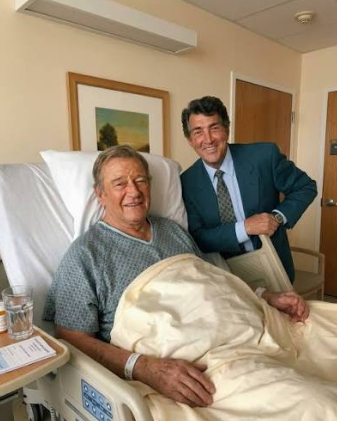
The other John Wayne crossing of path’s is the couple of times my mom ended up in Hoag Hospital in Newport Beach, she stayed in the John Wayne room, where he stayed when he was at Hoag (pictured below). To be clear Dean Martin did not visit my mom.
The second Iowa treat was the Field of Dreams, it’s worth the trip to hear the story and tour the home. We went to college with Kevin Costner; he was a couple of years older than us. Kevin, did finish his BA in Business Marketing degree, but then got distracted by the acting bug, which seems to have paid off for him as 10 years later he starred in the Field of Dreams.
Maybe the driving decision to play that role was the fact he graduated in 1978, and in 1979, Cal State University Fullerton’s baseball team in their 4th year as a Division I school, won the College World Series. You can see his picture where he suited up in 2016, he suited up in the Titans baseball team gear, as he has been avid supporter of the team since the Field of Dreams days.

PRESERVE YOUR FAMILY HISTORY, TODAY
 PRESERVE YOUR FAMILY HISTORY, TODAY
Reach out to Dancestors Genealogy. Our genealogists research, discover, and preserve your family history so those stories don’t disappear.
No one is getting any younger, and memories fade every year, eventually slipping beyond our ability to recover them. Paper gets thrown in the trash; books survive.
We offer:
– Documented, sourced reports, not unsourced online trees
– Printed books and reports that keep your family’s story alive
Ready to embark on your family history journey?
Call Dan Nelson at 214-914-3598 and get your project started today.
