


30 May Ancestry Newsletter- May 30, 2026
Contents
- 1 GENEALOGY- THE NEWSLETTER PODCAST STYLE!
- 2 TRACING THE PATRIOT TO THE JEWELER
- 3 FROM ADAM AND EVE TO TODAY. THE ASPIRATIONAL AND SPECULATIVE TREE EXAMINATION IS COMPLETE
- 4 MORE ON THE YELLOW ROSE OF TEXAS ‘er NEW YORK CITY
- 5 WHICH WAR, AND WHAT CAN YOU SEE THROUGH THE SMOKE, ANYWAYS?
- 6 SAME CROSSING 350 YEARS LATER
- 7 SLAVES WITH SURNAMES
- 8 PRESERVE YOUR FAMILY HISTORY, TODAY
GENEALOGY- THE NEWSLETTER PODCAST STYLE!
You can now listen as well as read the Dancestors Genealogy Newsletter.
Listen to all Dancestors Genealogy newsletters on our podcast page.
 TRACING THE PATRIOT TO THE JEWELER
 TRACING THE PATRIOT TO THE JEWELER
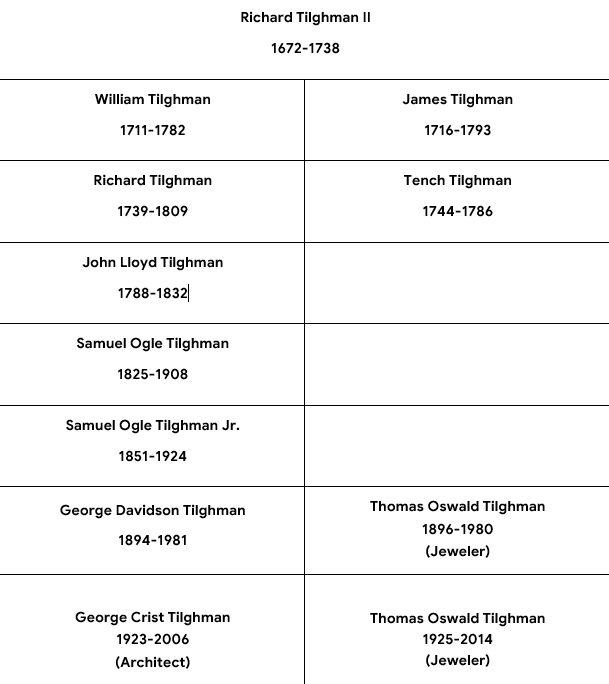
In our travels, we visited the Maryland State Capitol, the oldest in America. I remembered when I was a young teenager visiting Annapolis with my uncle, a Maryland architect, who pointed out the Tilghman Jewelers store across from the Capitol and said his partner was from that family.
In the State House, there was an exhibit on Lt. Col. Tench Tilghman, who was at Yorktown with Washington, and I imagined it was the same family, so I worked on seeing how they were related. You can see on the chart that my uncle’s partner at Nelson Tilghman and Associates was the architect George Crist Tilghman, and his uncle, Thomas Oswald Tilghman, was the founder of Tilghman Jewelers.
Both George and Thomas were 1st cousins, once removed of Revolutionary War officer Lt. Colonel Tench Tilghman.
Tilghman was born on Christmas Day, 1744, at Fausley, a plantation owned by his father, James Tilghman (a noted loyalist). Tilghman was schooled by John Gordon, rector of St. Michael’s Parish. He was sent by his grandfather, Tench Francis, to Philadelphia in 1758, at the age of 14, to the Academy and College of Philadelphia (which later evolved into the University of Pennsylvania), from which he graduated in May 1761. Tilghman then became a partner in Francis-Tilghman Company, a mercantile business formed with his Uncle Tench Francis, Jr. The enterprise was initially successful but dissolved in 1775.
In July 1775, the Second Continental Congress appointed him as one of the commissioners tasked with making treaties with Indians along the frontier, seeking to ensure their neutrality in the American Revolutionary War.
In the summer of 1775, Tilghman became a lieutenant in the 3rd Battalion of the Philadelphia volunteer light infantry company. The company was integrated into the Continental Army in New Jersey in the Flying Camp military formation in June or July 1776. On August 8, 1776, he became one of George Washington’s aides-de-camp.
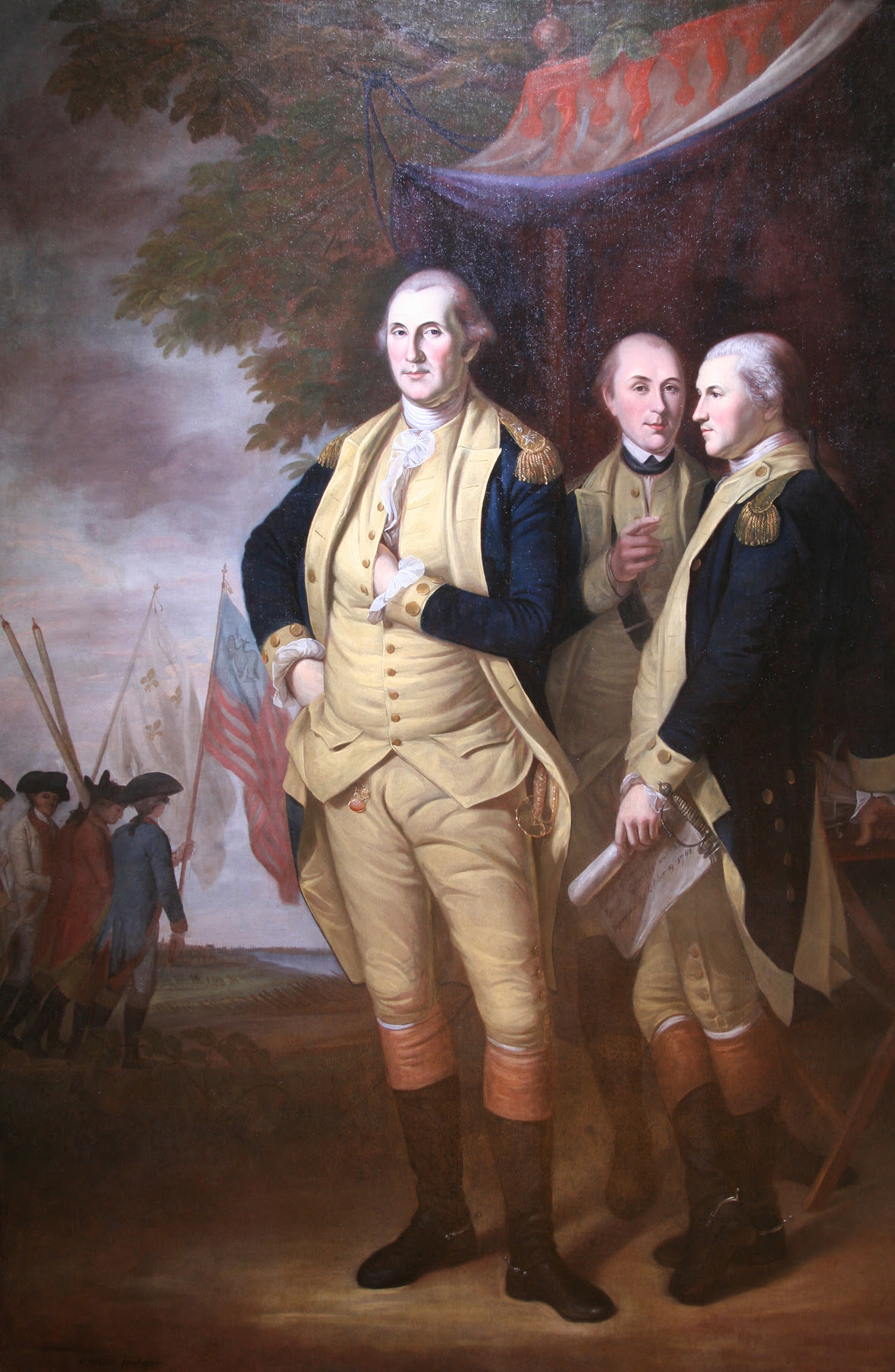
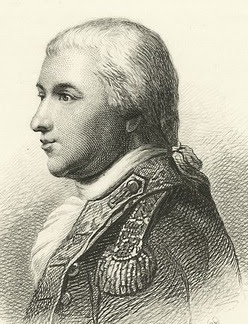
Tilghman served Washington as secretary until the end of the war, mostly without pay. Before Colonel Alexander Hamilton (then a young artillery officer) joined Washington’s staff, Tilghman was the only aide-de-camp to Washington who was conversant in French, a critical skill given the many French military men who had joined the revolutionary cause. During the Battle of Monmouth in 1778 and afterward, Tilghman interpreted written and verbal communications among Washington, Lafayette, von Steuben, and the commanders of the Continental Army’s French allies. You can see the portrait below of Washington, Tilghman, and Lafayette. Tench’s portrait is adjacent.
Tilghman’s Patriot loyalties split his family. He became the first among his eleven siblings to join the Revolutionary cause. Most of the Tilghman family served the King, as did many other rich families at that time. His brothers Richard and Philemon served in the British military. Another brother, William Tilghman, wanted to follow in their father’s footsteps and study law in England, creating a professional conflict for Tench Tilghman, who refused him passage to England on June 12, 1781.
The Siege of Yorktown in October 1781 culminated in a Patriot victory and an honor for Tilghman, whom Washington picked to carry the surrender papers to the Continental Congress in Philadelphia. On October 29, 1781, the Continental Congress voted Tilghman “a horse properly caparisoned and an elegant sword in testimony of their high opinion of his merit and ability.”
In a letter to Tilghman the following year, Washington’s humor and admiration are apparent:
Till your letter of the 28th arrived, which is the first from you and the only direct account of you since we departed at Philadelphia, we have various conjectures about you. Some thought you were dead—others that you were married—and all that you have forgot us. Your letter is not a more evident contradiction of the first and last of these suppositions than it is a tacit conformation of the second and as none can wish you greater success in the prosecution of the plan you are upon than I do…you have no friend who wishes more to see you than I do.
Tilghman died on April 18, 1786, at the age of 41. After Tilghman’s death, Washington wrote to his brother Thomas Ringgold Tilghman and to his father James Tilghman:
As there were few men for whom I had a warmer friendship, or greater regard than for your Brother—Colonel Tilghman—when living; so, with much truth I can assure you, that, there are none whose death I could more sincerely have regretted. and I pray you, & his numerous friends to permit me to mingle my sorrows with theirs on this unexpected & melancholy occasion.
Of all the numerous acquaintances of your lately deceased son, & amidst all the sorrowings that are mingled on that melancholy occasion, I may venture to assert that (excepting those of his nearest relatives) none could have felt his death with more regret than I did—No one entertained a higher opinion of his worth, or had imbibed sentiments of greater friendship for him than I had done.
FROM ADAM AND EVE TO TODAY. THE ASPIRATIONAL AND SPECULATIVE TREE EXAMINATION IS COMPLETE
 FROM ADAM AND EVE TO TODAY. THE ASPIRATIONAL AND SPECULATIVE TREE EXAMINATION IS COMPLETE
We left off in the last edition with William Palmer. The line then goes to Henry Palmer, born in 1615, and one tree has William Palmer, born in 1581 in Parham, Plomesgate, Suffolk, England. He died on November 13, 1637, at Duxbury, Plymouth, Massachusetts.
William was a nailer – his inventory included a bellows, an anvil, a vice, and all the tools necessary for nailmaking. He sailed on the Fortune in 1621 and received a two-acre grant as a passenger on that ship – one acre for his servant William Carvanyell and one for himself. His son William also accompanied him on the Fortune but was not yet 10 when the land grants were issued. His wife, Frances, followed Anne and received one acre, indicating she was not accompanied by any children over the age of 10. In the 1627 division, William, Francis, and William, Jr. are on the list. William was taxed £1 7s in 1633 and 18s in 1634.
He was not the son of John (William) Palmer and Elizabeth Virney, often given as baptized in 1585. That’s actually a burial record. He was not a Parham descendant, which would have been a big shift in class to go from Parham to immigrant.
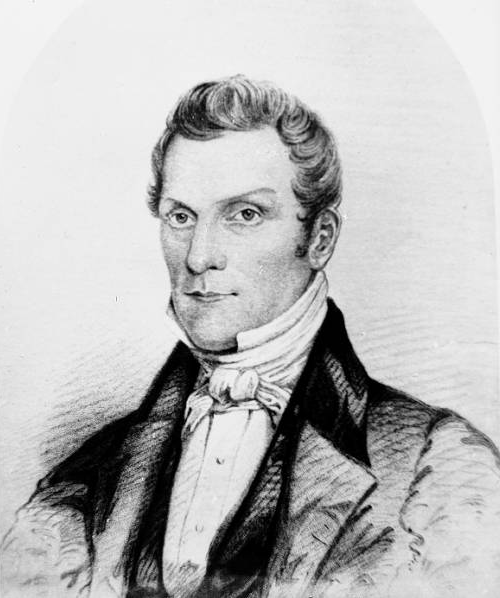
The tree conveniently merges the two Williams when there is no proof that they are the same people. From the unproven William, the line goes to a Henry Palmer, Deborah Palmer, Hannah Jones, Deborah De Wolf, Hannah Huntley, Solomon Mack, Lucy Mack, and finally to someone known, Hyrum Smith (pictured above).
Hyrum Smith (1800 – 1844) was the older brother of the Mormon Church (Latter Day Saints) movement’s founder, Joseph Smith, and was killed with his brother at Carthage Jail where they were being held awaiting trial.
When warned of possible danger, Joseph urged Hyrum Smith and his family to flee to Cincinnati, Ohio. Hyrum refused and, in 1844, traveled with Joseph to Carthage, Illinois, where both were charged with riot and treason. Joseph, Hyrum, John Taylor and Willard Richards were held awaiting trial in a jail in Carthage. On June 27, 1844, the building was attacked by a mob of between sixty and two hundred men. While attempting to barricade the door to prevent the mob from entering, Hyrum was shot in the face on the left side of the nose. After staggering back, another ball fired through the window struck him in the back, passed through his body, and struck his watch in his vest pocket. As Hyrum Smith fell to the floor, he exclaimed, “I am a dead man,” as he died. Taylor was struck by several bullets but survived with the help of Richards. Joseph was hit by at least two shots, exclaimed “O Lord, My God,” and fell through a second-story window to the ground where he was shot again.
From there the line descends through his daughter Martha Ann Smith, William Jasper Harris, John Ernest Harris, and from there to folks that are or could be alive today, so I won’t mention them. So, it was an aspirational reach back to Adam and Eve, but hardly provable, or even probable.
MORE ON THE YELLOW ROSE OF TEXAS ‘er NEW YORK CITY
 MORE ON THE YELLOW ROSE OF TEXAS ‘er NEW YORK CITY
About a year ago, I wrote about my wife’s ancestor, George Folliott Harison who cultivated the Yellow Rose of Texas in New York City. GEORGE HARISON. If you live in Texas, it sounds like a Pace Picante sauce commercial.
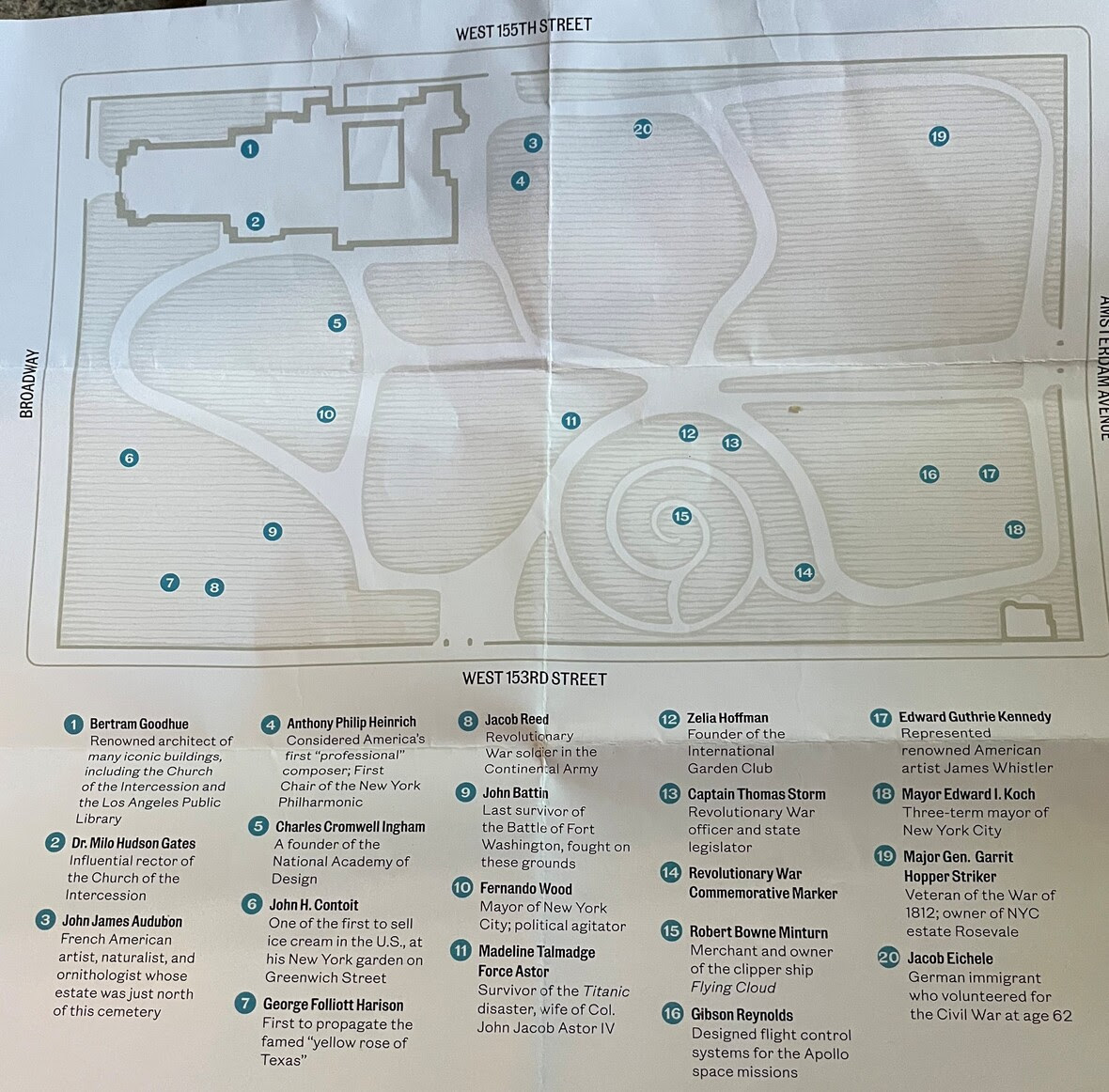
While we were in NYC, we visited his grave. That was more complicated than we thought. We thought he was buried in the Church of Intersession Cemetery. They told us to go to the next-door Trinity Cemetery, get a brochure from the gate, and call the Trinity office to see if they could tell me where he was buried. I did so, and we found out that he’s buried in the Trinity Cemetery. They did not know I had gotten their number from the brochure, because when I got down to the office, they gave me the same brochure (pictured) and showed me that George was one of the 20 famous people buried in that cemetery. Other well-known people include John James Audubon and Mayor Ed Koch.
Most people who have visited NYC would know of Trinity Church in Lower Manhattan. The cemetery managers shared with me that the parish established a second cemetery after New York City prohibited new burials in lower Manhattan in 1823 due to health concerns and disease outbreaks, including cholera. The Upper Manhattan Trinity Cemetery remains the only active cemetery on the island of Manhattan today.
They also shared that George’s yellow roses were planted and growing over the wall at the corner of Broadway and 155th Street (pictured below).
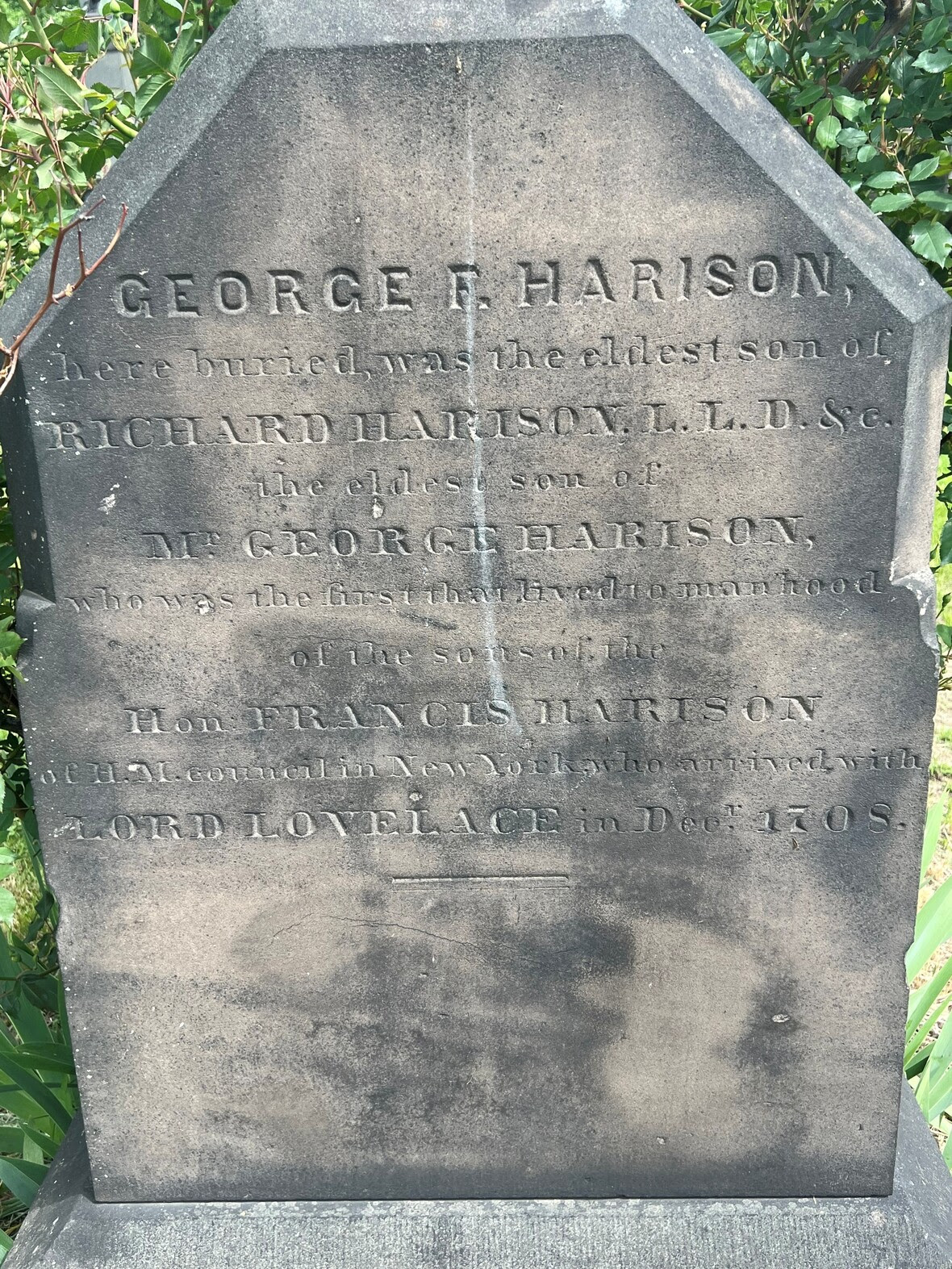
We checked in on George’s gravestone (pictured) to see if it also had yellow roses growing around it, and yes, there was a rose bush, but it wasn’t in bloom. However, we noticed it has some genealogy recorded on it, saying that George was the son of Richard Harison, who was the son of George Harison, the son of Frances Harison, who came to America in 1708 with Lord Lovelace.
Richard was an attorney and Federalist politician. We reported on him back in 2024. RICHARD HARISON He practiced law in partnership with Alexander Hamilton. He served as Deputy Grand Master of the Masons of NY, a delegate to the NY Convention, and a member of the NY State Assembly. Harison was appointed by President George Washington as the first US Attorney for the District of NY.
His father, George, was also an attorney, and his father Frances was a lawyer and politician in colonial New York until he returned to England.
So who was Lord Lovelace? He was the 4th Baron John Lovelace. His father had weakened the family’s fortunes through gambling, leaving John heavily in debt. He served in the military following the inheritance of his peerage. In 1701, Lord Lovelace married Charlotte, the daughter of Sir John Clayton, but her poor dowry did little to improve his financial situation. The couple had six children.
Lovelace was described by a Scottish writer as follows: “Lieutenant Colonel of the Horse Guards; a very pretty gentleman of good sense and well at court; a short, fat brown man, not forty years old.”
On 21 March 1708, Lord Lovelace was appointed governor of New York and New Jersey. After a harrowing nine-week trans-Atlantic voyage, Governor Lovelace, his wife, and three sons arrived in New York on 18 December 1708. He was well received by the Assemblies of both colonies. Lord Lovelace was granted £1,600 by a revenue bill on 5 May 1709. However, during the last month of his six-month tenure, two of the Governor’s sons died, probably of pneumonia, and he himself died on 6 May 1709. His wife and remaining children returned to England.

WHICH WAR, AND WHAT CAN YOU SEE THROUGH THE SMOKE, ANYWAYS?
 WHICH WAR, AND WHAT CAN YOU SEE THROUGH THE SMOKE, ANYWAYS?
My wife’s 2X Great-Grandfather wrote about his grandfather, Richard Franklin, during the Revolutionary War.
“Once, Richard was in Baltimore, Maryland, when a shipload of the King’s Troops approached the shore but was too far off to be seen with the naked eye. With the aid of a field glass, the bright buttons on their redcoats could be seen.”
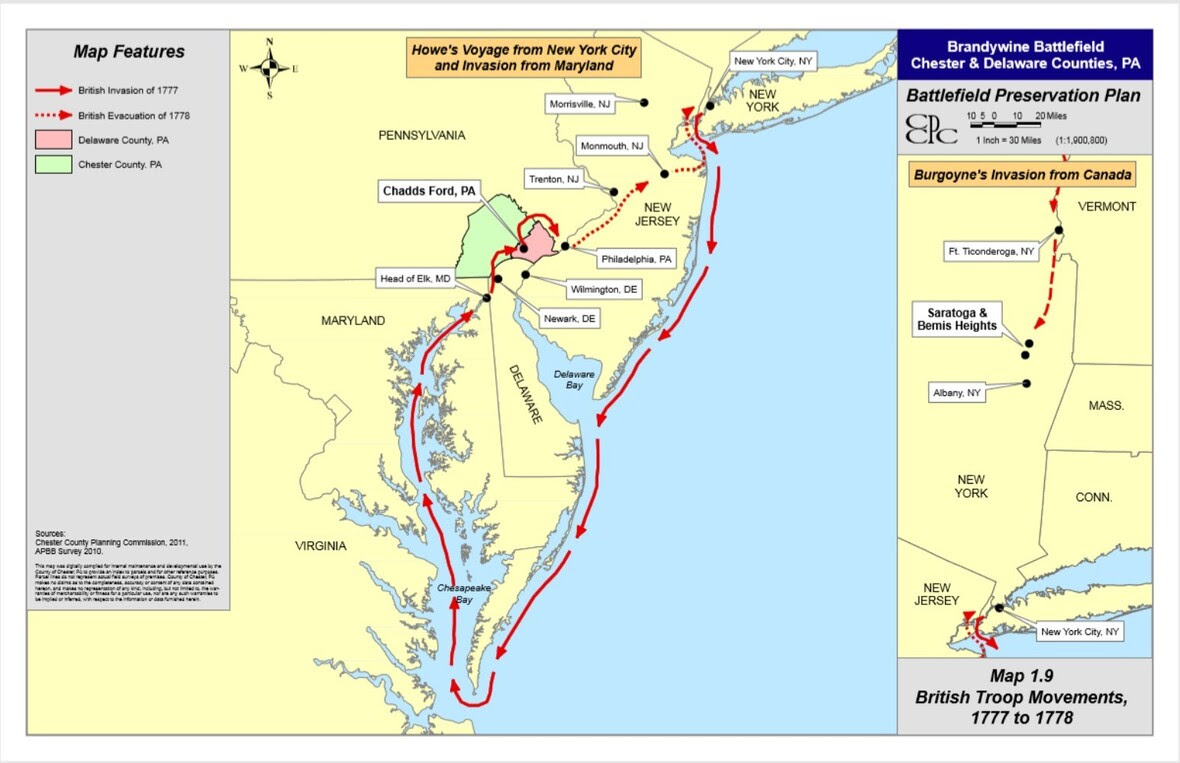
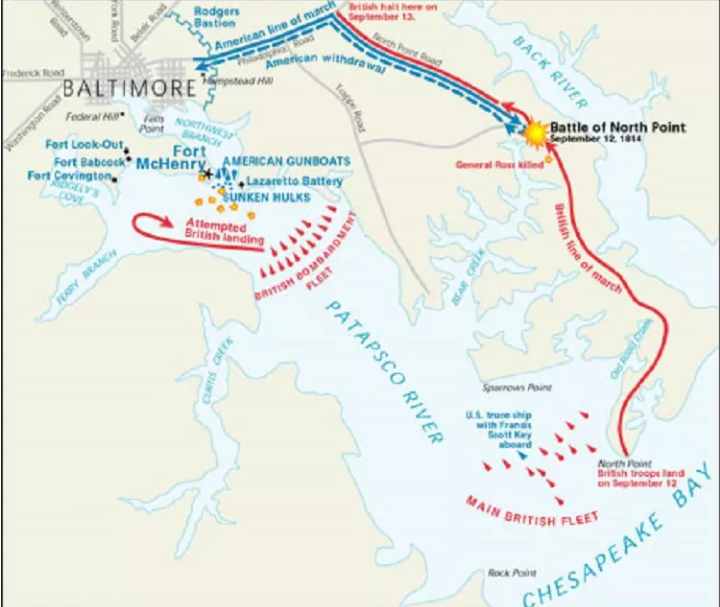
The only problem is that the King’s Troops never came toward Baltimore. They snuck up the east side of the Chesapeake Bay to invade Philadelphia, leading to the Battle of the Brandywine. You can see the journey on the map on the left below.
Richard might have been too young to have served in the Revolution, so I wondered if it was the War of 1812. We recently visited Fort McHenry, and I asked whether what Richard saw could be seen from Baltimore. They said it was unlikely unless he was on a rooftop and got lucky, as once the ships got close enough to potentially see soldiers’ coat buttons, the smoke from the bombardment and the return fire of the fort, it was all hazed over, and the two sides couldn’t see each other (see the map on the right below).
That was part of the inspiration for Francis Scott Key to write the Star-Spangled Banner, as, with a field glass from the British ships at the mouth of the Patapsco (see the map on the bottom right), he strained to finally see the American flag come morning.
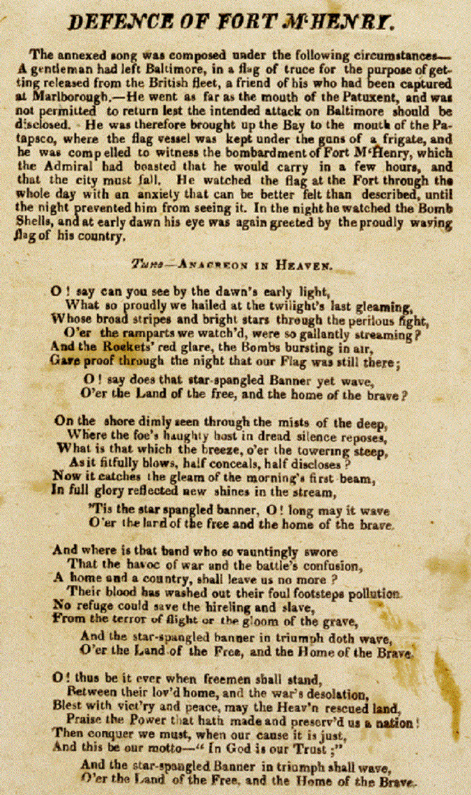
Key’s song caused some later controversy when it was discovered that it had been set to a British tune (see the top picture).
SAME CROSSING 350 YEARS LATER
 SAME CROSSING 350 YEARS LATER
As we rode the ferry from Pier 11/Wall Street in NYC and saw the Brooklyn skyline, I thought about my 8th Great Grandfather, Joannes Nevius, who owned the Ferry to Brooklyn, and wondered what he would think of today’s views of Brooklyn and Manhattan.
Joannes Nevius was baptized on 14 March 1627 at his father’s church in Zoelen, Gelderland, in the Dutch Republic. Nevius entered the University of Leyden in 1646. In 1651 (or possibly 1650), he sailed to America. When he landed in Manhattan, it contained perhaps 1,000 inhabitants. Peter Stuyvesant was the governor.
Joannes Nevius was probably a merchant when he first arrived. On March 13, 1653, he was assessed 100 guilders to help pay for the city’s defensive wall (the origin of Wall St.). On November 18, 1653, he married Adriaentje Bleijck. On November 22, 1653, he signed a “Remonstrance of the Merchants of New Amsterdam in Regard to the Imposition of Import Duties.”
He owned a lot at what is now 80 Broadway and may have had his house there. This land was taken from him by the city on May 3, 1657, for a parade ground, and is now residential condominiums at 1 Wall Street.
On December 8, 1654, Joannes Nevius was named a city Schepen (filling the term of a Schepen who had been murdered). A Schepen was a Dutch position that was judge, juror, and city councilor. There were five city Schepens and two Burgomasters, who sat as magistrates and city council in the Court of Burgomasters and Schepens at the Stadt Huis, or city hall. On January 31, 1655, his term as Schepen was renewed for one year.
On March 2, 1655, Nevius purchased a house on the north side of Pearl St. (present nos. 35 & 37). He probably moved to this house from the house at 80 Broadway.
On February 7, 1656, Nevius’ term as Schepen expired. Sometime during 1656, he bought land in Brooklyn, at “The Ferry.”
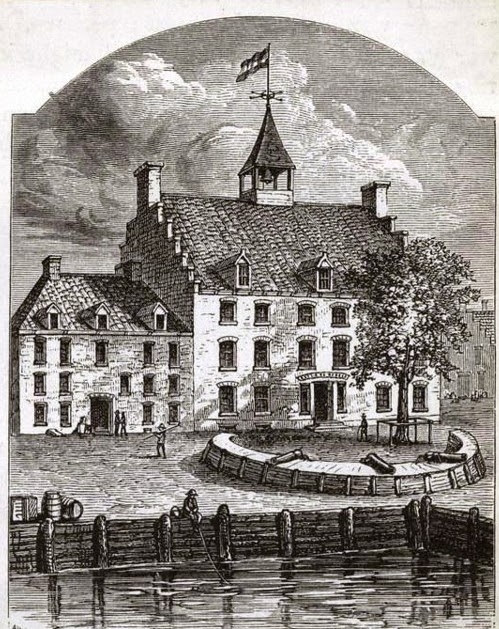
In October 1657, he was sworn in as City Secretary. He resided in the Stadt Huis (71 & 73 Pearl St.) (pictured), the state house of the New Amsterdam government. He kept the minutes of the Court of Burgomasters and Schepens, recorded deeds, and prepared official documents. He was also vendue master, i.e., he conducted all public sales (for a fee of 3 guilders per transaction), and he was law librarian. From this time, started spelling his name consistently “Joannes” instead of “Johannes.”
On September 6, 1664, the British took New Amsterdam and renamed it New York. In October, all the inhabitants were required to swear an oath of allegiance to King Charles II. Joannes Nevius continued as City Secretary under the British. On June 12, 1665, the city government was restructured after the British model of mayor, aldermen, and sheriff. On June 19, it was found that the City Secretary could not keep minutes in English, and on June 27, Joannes resigned his position.
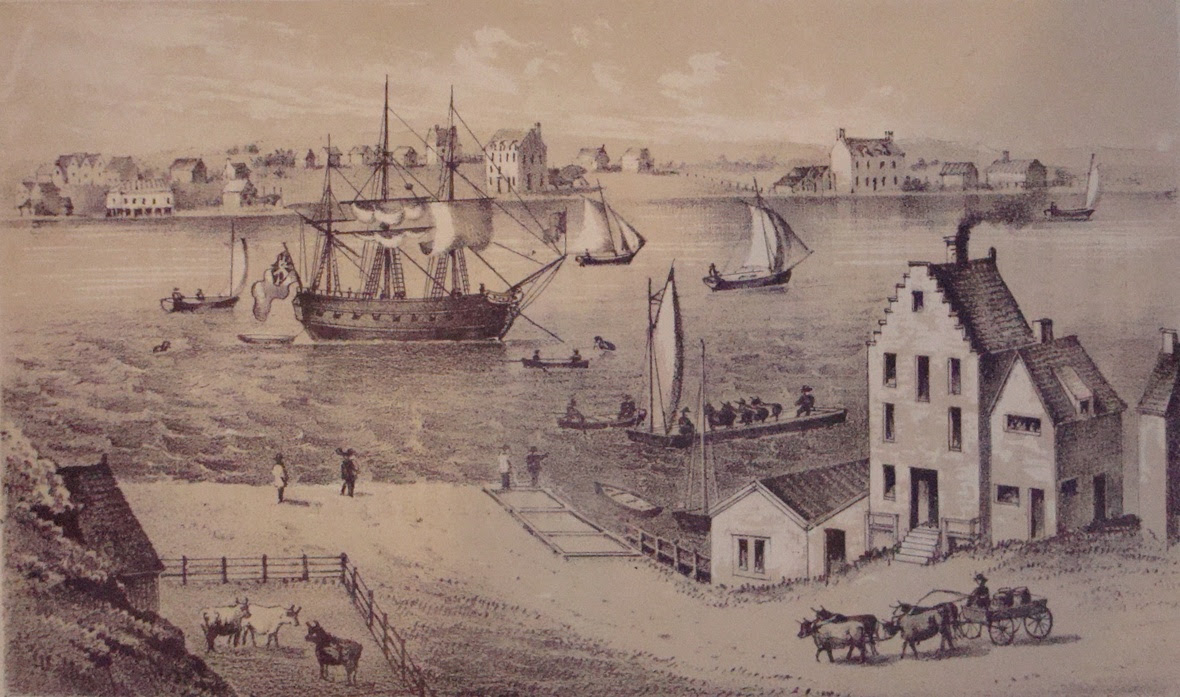
The Nevius family moved out of Stadt Huis and onto Hoogh (High) Street. By about 1670, Joannes Nevius and family were on the other side of the East River in Brooklyn, leasing and living in the ferry house there. He ran the ferry (probably hiring ferrymen) and a tavern in the ferry house. The Fulton Ferry House in Brooklyn, pictured below Descendant in 1746.
Joannes Nevius died in May or June 1672, as by June 10, 1672, his wife had signed a petition to hold the ferry house as “widow,” and later remarried Jan Aersen, Ferrymaster, and had four more children. She died in 1689 at age 53.
SLAVES WITH SURNAMES
 SLAVES WITH SURNAMES
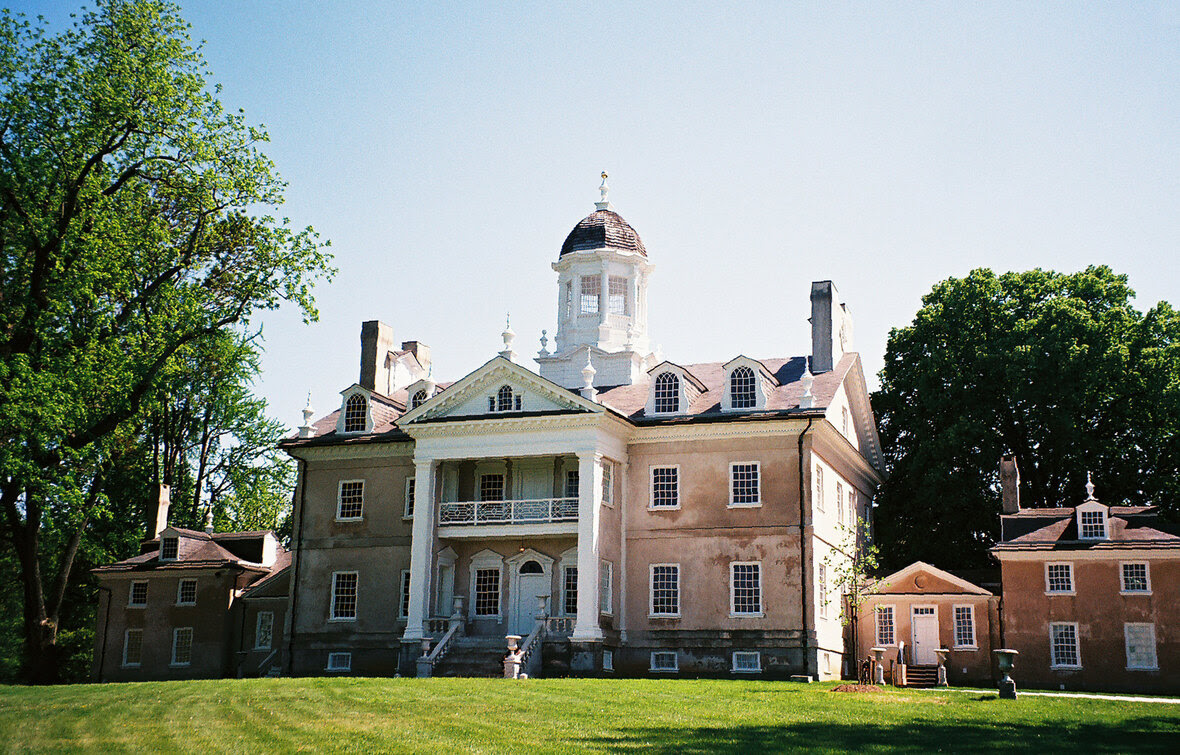
On a recent trip, we visited Hampton. The estate was owned by the Ridgely family for seven generations, from 1745 to 1948.
On April 2, 1745, to Col. Charles Ridgely (1702–72), purchased the land. By the late 1750s, Hampton extended to more than 10,000 acres and included an ironworks. His son, Capt. Charles Ridgely (1733–90), expanded the family business considerably to include gristmills, apple orchards, and stone quarries. During the American Revolutionary War, the ironworks was a significant source of income for the Ridgely’s, producing cannons and ammunition for the Continental Army. In 1783, Capt. Ridgely began construction of the main house, Hampton Mansion. He said its concept was inspired by Castle Howard in England, owned by relatives of his mother. When it was completed in 1790, the Hampton Mansion was the largest private home in the United States.
When Capt. Ridgely died that same year, his nephew, Charles Ridgely Carnan(1760–1829), became the second master of Hampton, as Capt. Ridgely had no children. The deal was Carnan had to change his name to Charles Carnan Ridgely, and then he would inherit Hampton. No doubt it took about 5 seconds to say yes to that offer.
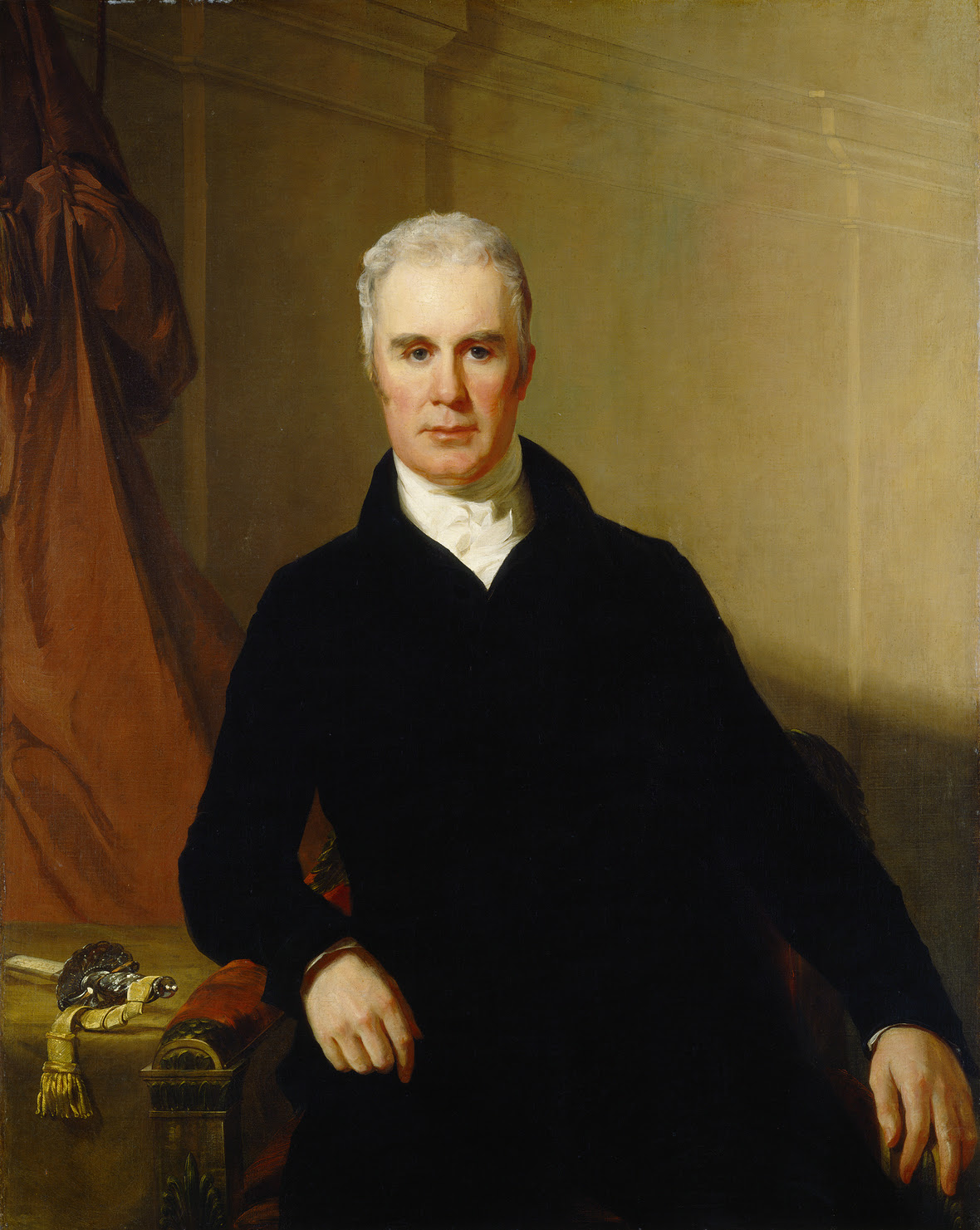
Charles Carnan Ridgely frequently entertained prominent guests in the Mansion’s Great Hall, such as Charles Carroll of Carrollton (1737-1832), who was the last surviving signer of the Declaration of Independence, and American Revolutionary War general and Frenchman, Marquis de Lafayette. Charles Carnan served as Governor of Maryland between 1816 and 1819. When Governor Ridgely died in 1829, he freed a portion of Hampton’s slaves in his will.
The Hampton estate was split among various heirs, with his son, John Carnan Ridgely (1790–1867), inheriting the mansion and 4,500 acres. The ironworks closed and thereafter the Ridgely’s’ income was primarily derived from farming, investments, and their stone quarries. John married Eliza Ridgley, his fifth cousin.
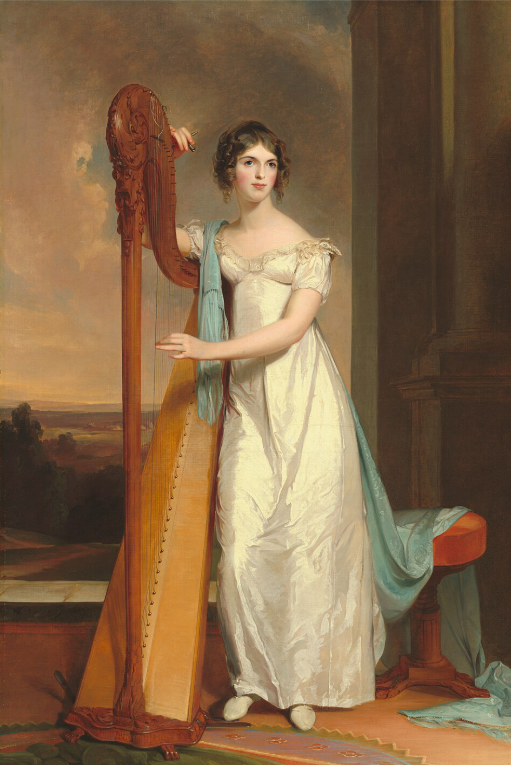
The portraits of Charles Carnan and his daughter-in-law Eliza Ridgely (below) were painted by Thomas Sully. In the 1940’s when the National Gallery of Art was amassing a collection of Sully portraits they sent an agent to Hampton to acquire the paintings, and they saw how the mansion was in disrepair, and efforts were made to purchase the estate and turn it over to the National Park Service.
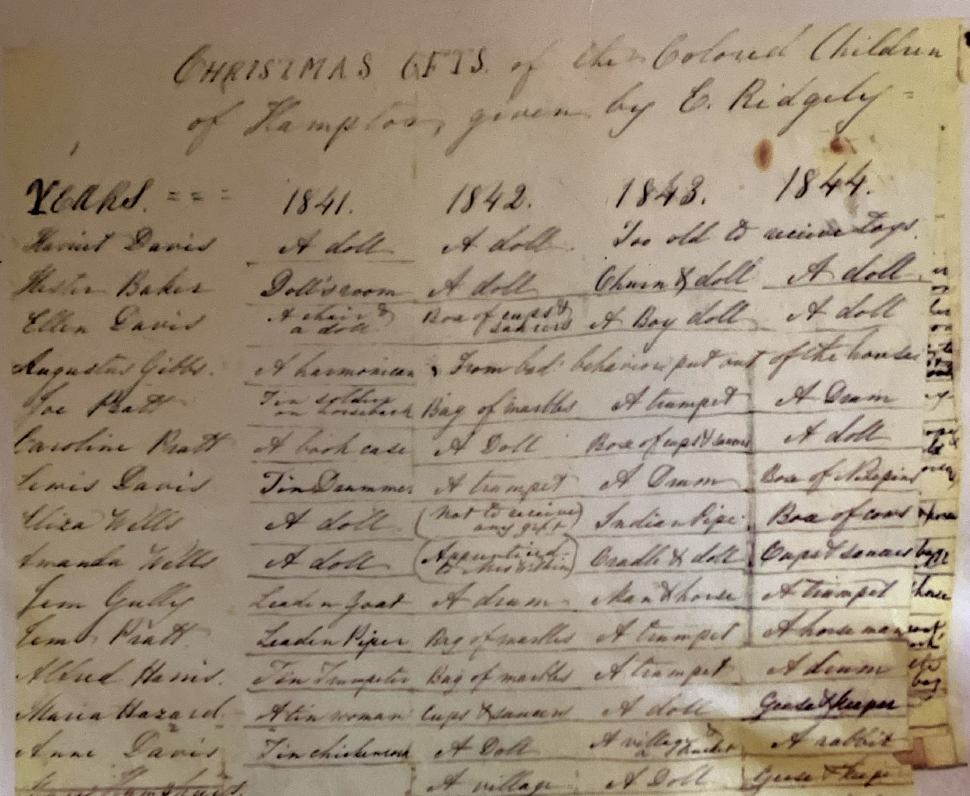
One of the unusual items we came across at Ridgely was the Christmas gift lists (top left) for the slave children, all had surnames, which were not Ridgely. That was an uncommon practice to give slaves a surname, or one that was not the master’s name.
PRESERVE YOUR FAMILY HISTORY, TODAY
 PRESERVE YOUR FAMILY HISTORY, TODAY
Reach out to Dancestors Genealogy. Our genealogists will research, discover, and preserve your family history. No one is getting any younger, and stories disappear from memory every year, eventually fading from our ability to find them.
Preserve your legacy and the heritage of your ancestors.
Paper gets thrown in the trash; books survive!
Ready to embark on your family history journey? Don’t hesitate. Call Dan Nelson and get your project started!
