

02 May Ancestry Newsletter – May 2, 2026
Contents
- 1 ANCESTRY- THE NEWSLETTER PODCAST STYLE!
- 2 DID A SPANISH EARLY BIRD INHERIT THE LAND, AND THEN DISCOVER AMERICA?
- 3 FROM ADAM AND EVE TO THE STRADLINGS
- 4 HARRIET DIDN’T HAVE A CINDERELLA STORY
- 5 IF THIS MAN HAD LIVED, THERE COULD HAVE BEEN A PRESIDENT BLYTHE
- 6 “A GUNFIGHT IN FRONT OF CITY HALL*
- 7 CHECKING IN ON GREAT-GREAT-GRANDPA’S CIVIL WAR DIARIES
- 8 PRESERVE YOUR FAMILY HISTORY, TODAY
ANCESTRY- THE NEWSLETTER PODCAST STYLE!
You can now listen as well as read the Dancestors Genealogy Newsletter.
Listen to all Dancestors Genealogy newsletters on our podcast page.
 DID A SPANISH EARLY BIRD INHERIT THE LAND, AND THEN DISCOVER AMERICA?
 DID A SPANISH EARLY BIRD INHERIT THE LAND, AND THEN DISCOVER AMERICA?
edro Álvarez de Soutomaior (c. 1430 – 1486), known by the sobriquet Pedro Madruga, was the illegitimate son of Fernán Eanes de Soutomaior. When Fernán died, his estates passed to his legitimate son, Alvaro. However, Alvaro died unmarried, and although the next legal heir was Alvaro’s aunt, provision was made, with her agreement, to allow Pedro to inherit the estates instead. He was subsequently legitimized by the sovereigns of Castile and Portugal and became Don Pedro Alvarez de Sotomayor. He married Teresa de Távora, who came from a noble Portuguese family. His children included Cristóbal de Sotomayor, who would sail with Diego Columbus (Christopher Columbus’s eldest son) to the West Indies. Cristóbal would become governor of Puerto Rico.
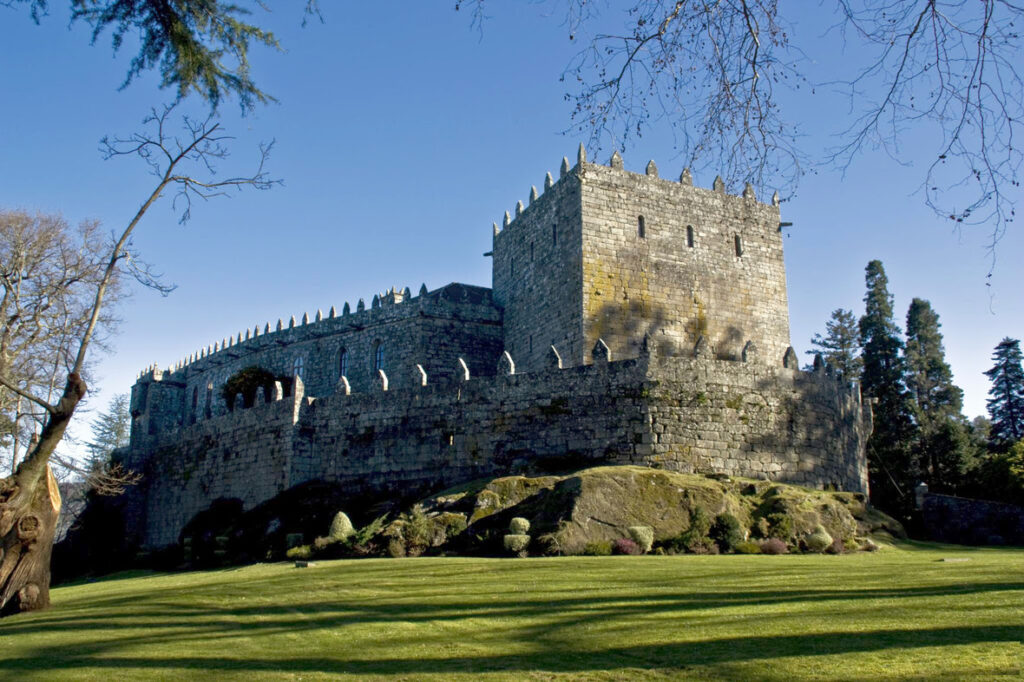
Pedro’s ancestral home was Soutomaior Castle (pictured below), although he also resided at times in the courts of Castile and Portugal.
Pedro Álvarez de Sotomayor acquired the epithet “Madruga” because he would “rise early” in the morning. According to legend, he first earned the nickname after a dispute with the Count of Ribadavia over the boundaries of their respective lands. To settle the dispute, the two men agreed to rise at the first cockcrow, mount their horses, and ride toward each other’s castle. Their meeting point would mark the new boundary. Instead of waiting until dawn, Pedro Alvarez decided that the first cockcrow was at midnight and so rode through the night until he reached his rival’s castle. When the Count emerged on hearing the dawn cockcrow, he found don Pedro standing at his door, and exclaimed “Madrugas Pedro, madrugas!” (You’re an early riser, Pedro; An early riser).
Pedro Madruga was a figure in the court of Henry IV of Castile, and the king entrusted him with the role of keeping the powerful Bishop of Santiago, Alonso de Fonseca, under control.
In the 1460s, the second Irmandiño revolt erupted in Galicia when the peasantry rebelled against the regional nobility. Pedro Madruga had already sought refuge in Portugal. At the nobles’ request, he raised an army and confronted the irmandiños on several occasions, finally subduing them.
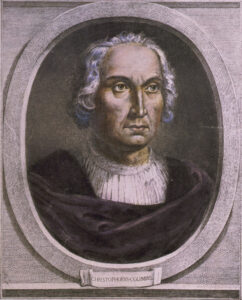
In the late 19th century, the Spanish writer García de la Riega proposed the theory that Christopher Columbus (pictured) was of Galician origin. Although briefly popular, the theory had fallen out of favor by the late 20th century. However, in recent years, it has been proposed that Pedro Madruga and Christopher Columbus were the same person. According to this theory, Madruga did not die in 1486 but changed his identity to disguise a pact between his former enemies, the Catholic Monarchs, and himself.
This thesis is based on several lines of evidence, such as Columbus naming coastal features of the West Indies after more than 100 localities in the Pontevedra estuary (near Soutomaior in Galicia) and the similarity between the handwriting of Columbus and that of Pedro Madruga. One argument against is a will drafted in 1491 by Alvaro de Sotomayor, the eldest son of Pedro Madruga. In this document, Alvaro stipulates that “the bones of my parents … be brought to be interred in the chapel of S. Obispo D. Juan in the Cathedral Church of Tuy,” although this document implies that Pedro Madruga was dead in 1491 rather than 1486.
Now, a genetic study of Columbus’ DNA supports this theory, and who knows what more genetic studies may yield. Click on the link to read more.
Galician genes: New study suggests Christopher Columbus was from Spanish nobility.
Of course, the eventual question that may be answered is: if this turns out to be accepted, does the only modern famous Sotomayor, Supreme Court Justice Sonia Sotomayor, who is of Puerto Rican descent, descend from Pedro Madruga?
FROM ADAM AND EVE TO THE STRADLINGS
 FROM ADAM AND EVE TO THE STRADLINGS
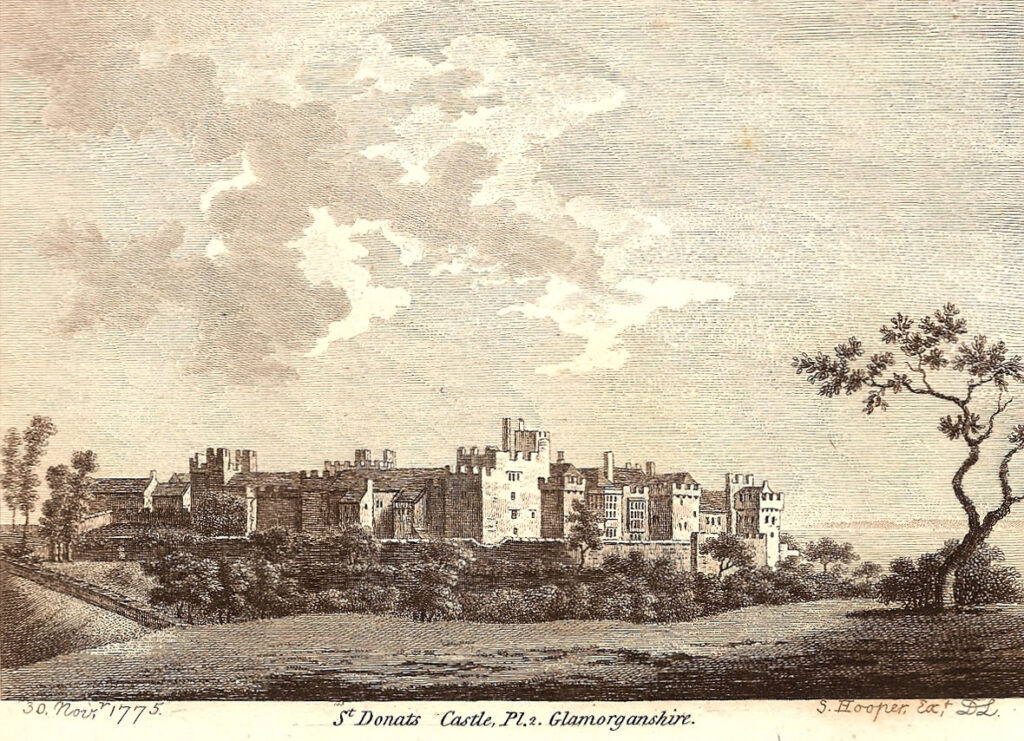
In the last edition, we left off with Sir Knight Edward and Jane Beaufort Stradling. STRADLINGS St Donat’s Castle in Donats, Wales, is a medieval castle in the Vale of Glamorgan, about 16 miles (26 km) west of Cardiff and about 1+1⁄2 miles (2.4 km) west of Llantwit Major. Positioned on cliffs overlooking the Bristol Channel, the site has been occupied since the Iron Age and was, by tradition, the home of the Celtic chieftain Caradog. The present castle’s origins date to the 12th century, when the de Haweys and, later, Peter de Stradling began its development. The Stradlings held the castle for four hundred years, until the death of Sir Thomas Stradling in a duel in 1738.
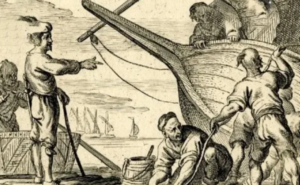
In 1449, their son Henry, with his family, was taken by the Breton pirate Colyn Dolphin (above) as they crossed the Bristol Channel from Somerset. They were held at Saint-Malo for a ransom of 1000 marks. Edward was forced to sell manors in Oxfordshire and southeast Wales, along with large quantities of wood, to raise the sum and free the captives in 1451, which is good he did, as the line continued on through Sir Knight Henry (Harry) Stradling.
From the inscription on his tomb- the undernamed Harry Stradlinge, kt., went on pilgrimage to Jerusalem, and received the order of the Sepulcher there, as his father Edward Stradlinge, kt., the 5th [rect. ‘3rd’] of that name, did, and died in the Isle of Cyprus in his coming home, the last of August, in the 16 yere of K. Edwd. 4th, and is buried there in the city of Famagusta. This said, Harry Stradlinge, from his house in Wales, was taken prisoner by a Brytaine (Britain) Pirate named Colin Dolphin, whose redemption and charges stood him in 2200 marks, for the payment whereof he was driven to sell the castle and manor of Bassalleg and Sutton in Monmouthshire, and two manors in Oxfordshire.
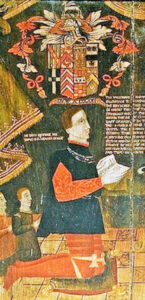
Henry’s son Sir Thomas Stradlinge, Esquire (pictured below left), from the inscription on his tomb- sonne to Harry Stradlinge, Knight, and Elisabeth his wyfe (the daughter of William Thomas of Raglan in the Countie of Monmouth, Knight) who dyed at Cardyffe in the Monastery of Preaching Fryers, on the 8 day of Sept. in the yere of our Lord 1480. whose… (after the Dissolution of the sayd Monasterie) Thomas Stradlinge, knight, his nephewe* [also can mean son or cousin in early England], caused to be taken up and caried to Saint Donatts and buried in the chauncell of the church there by his sonne the 4 day of June in the yere of our Lord 1537, and afterwards Edward Stradlinge, Knight, his nephewe, sonne of the 5th of that name, translated the said bones out of the chauncell into the chappell there in the yere of our Lord 1573. After whose death his wyfe married with Sir Rees ap Thomas, Knight of the Garter, and dyed at Picton in the county of Pembroke, the 5 day of February, in the yere of our Lord 1533, and was buryed at Carmarthen in the Church of the Monastery of Preachinge Friers with the said Sir Rees ap Thomas her husband.
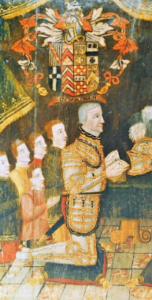
Thomas’ son Edward’s (pictured below right) inscription- Here lyeth Edward Stradlinge, Knight, the 4 of that name, sonne to Thomas Stradlinge, Esquier, and Jenet his wyfe (the daughter of Thomas Mathewe of Rader, in the county of Glamorgan, Esquier) who died in the Castell of Saint Donatts the 8 day of May in the yere of our Lord 1535, and was buried in the chauncel of the church there, whose bones were after translated by his nephewe Edward Stradlinge, Knight, the 5 of that name into the chappell there in the yere of our Lord 1573. Allso here lyeth Elizabeth his wife, daughter to Thomas Arundell of Lanheyron in the county of Cornewall, Knight, who dyed in childbead at Merthermawre the 20 day of February in the yere of our Lord 1513 and was buried there whose bones Thomas Stradlinge, Knight, her sonne, caused to be taken up and caryed to Saint Donatts and buryed in the chauncell of the church therewith her husband the 8 day of Maye in the yere of our Lord 1536, and were afterwards by Edward Stradlinge, Knight, the 5 of that name, her nephewe, translated out of the chauncell into the chappell there in the yere of our Lord 1573.
St Donat’s Castle (pictured below) in Donats, Wales, is a medieval castle in the Vale of Glamorgan, about 16 miles west of Cardiff and about 1+1⁄2 miles west of Llantwit Major. Positioned on cliffs overlooking the Bristol Channel, the site has been occupied since the Iron Age and was, by tradition, the home of the Celtic chieftain Caradog. The present castle’s origins date to the 12th century, when the de Haweys and, later, Peter de Stradling began its development. The Stradlings held the castle for four hundred years, until the death of Sir Thomas Stradling in a duel in 1738.
____
HARRIET DIDN’T HAVE A CINDERELLA STORY
In a June 2024 edition, I covered Alexander Bowers’ contract to train a boy to be a farmer. ALEX BOWERS Alexander’s granddaughter, Harriet Bowers Stiles Bruner, was mentioned in our article on the mysterious Solomon Howell Bruner. SOL BRUNER She was also mentioned in our report as being married to an abusive husband, but she didn’t want to press the issue, because, as a civil war widow, if she said she was married to him, she would lose her widow’s pension from her first husband.
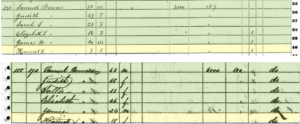
When I was first looking for Harriet’s parents, the 1850 and 1860 censuses (above) would easily make you think that she was the daughter of Samuel and Judith Bowers. However, in those census years, the relationships within the household were not captured, so the people are inferred to be spouses and children.
Note- the podcast interprets this as an egregious error by the census takers; it was not an error, as relationships were not part of what they were to gather.
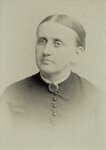
Samuel was the son of the aforementioned Alexander Bowers. However, my son-in-law’s great uncle had a box of old Gloucester County, NJ, deeds and such in his attic. Amongst those papers was Alexander’s will and documents showing that Harriet was the daughter of Samuel’s brother George and his wife Rachel Garrison Abrams (pictured below left).
The great-uncle wanted to sell the box of information, so I paid him $100 and sent what wasn’t family information to the Gloucester Historical Society, which helped with some family research.
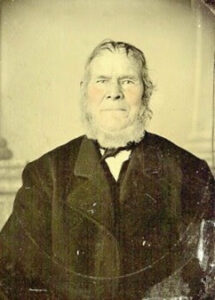
About 1845, the widow Rachel Garrison Abrams Bowers married the widower Abraham Cowgill (pictured below right). He was a waterman, working on the Delaware River. Abraham had two children from his first marriage, and he and Rachel had two of their own before the 1850 census. It is both interesting and sad that, in 1850, Harriet and her two sisters were living in other people’s households rather than with their mother and stepfather. We’ll never know why they were farmed out, but it wasn’t because Abraham didn’t like kids, as he and Rachel went on to have nine more children. So, between the two of them, they had 17 children in total from their two marriages.
When Abraham Cowgill died in 1892, Harriet was not an heir, which makes sense since she was not a blood descendant. However, Harriet’s sister, who was also not blood and was also farmed out, Catherine Bowers Tracy, was an heir and was also at the 1909 Cowgill reunion, whereas Harriet was not. Like most families, the answers as to why are lost to time.
IF THIS MAN HAD LIVED, THERE COULD HAVE BEEN A PRESIDENT BLYTHE
 IF THIS MAN HAD LIVED, THERE COULD HAVE BEEN A PRESIDENT BLYTHE
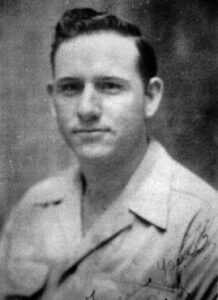
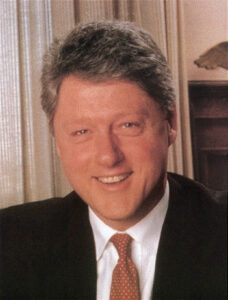
We visited President Bill Clinton’s childhood home in Hope, AR, where we learned about his father, William Jefferson Blythe Jr. (pictured adjacent).
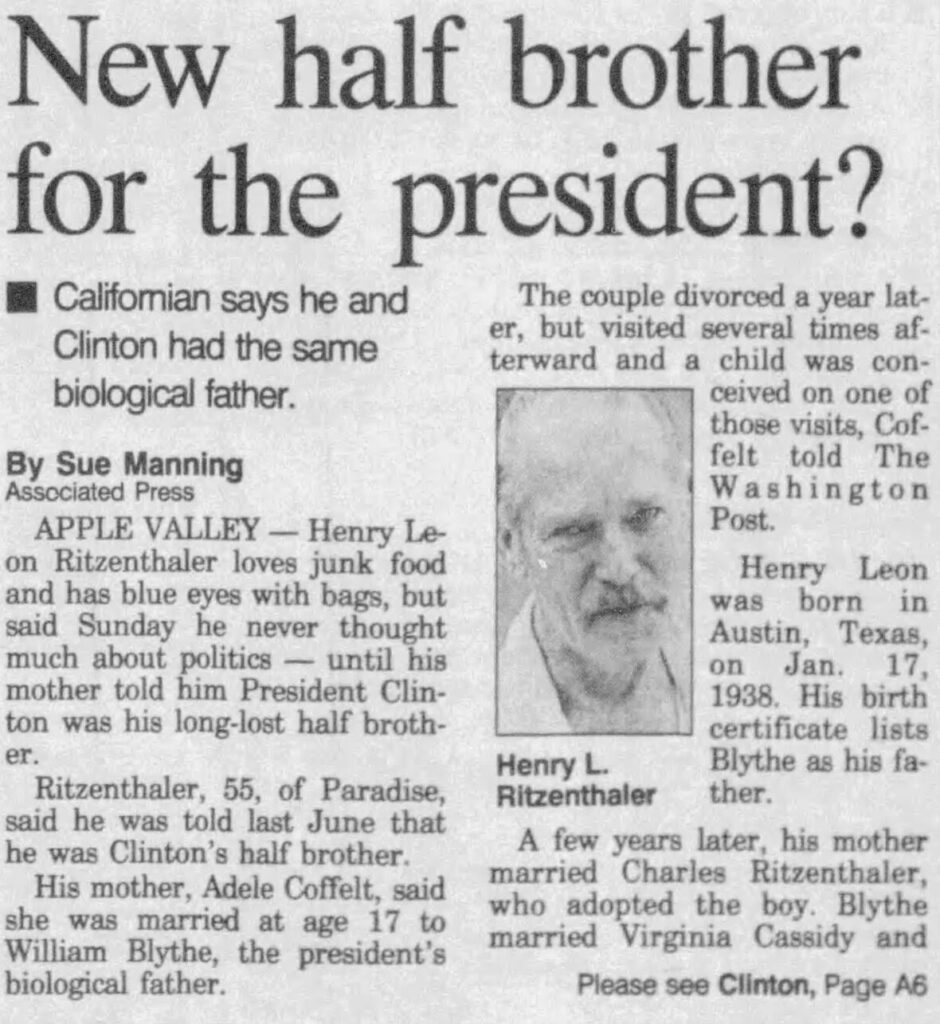
If his son had not become president, we’d likely never know or care that Blythe was married five times. He married for the first time in December 1935 to Virginia Adele Gash, when they were both 17; they divorced only 13 months later. However, Virginia Gash and Blythe remained friends, and she visited him on occasion. A son was conceived during these visits, and Henry Leon Blythe was born in Sherman, Texas, in January 1938, eighteen months after his parents had been divorced.
Blythe married his second wife, 21-year-old Maxine Hamilton, in August 1938; they divorced two weeks later.
Blythe then married Minnie Faye Gash, his first wife’s sister, in December 1940. The marriage was annulled four months later in April 1941, without children.
Shortly after the annulment on May 3, 1941, Blythe married again. His fourth wife was Wanetta Ellen Alexander of Kansas City, Missouri, and the wedding was held in Jackson County, Missouri. Wanetta gave birth to Blythe’s daughter on May 11, 1941, eight days after their wedding. She had become pregnant with Blythe’s child prior to his short-lived third marriage to Minnie. Their daughter, Sharon Lee Blythe Pettijohn, died on April 24, 2022. Blythe and Wanetta were formally divorced three years later, in April 1944, and lost touch immediately afterward.
Wanetta, who eventually settled in Tucson, Arizona, had no inkling of Blythe’s subsequent history until the 1992 presidential campaign and a Washington Post story. Upon seeing old photographs of Bill Clinton’s father flashed on TV, Wanetta “swears on a stack of Bibles … that that was the man she was married to”, said her son-in-law Bob Pettijohn, husband of her daughter Sharon.
Blythe’s divorce from Wanetta was granted in court on April 13, 1944. Seven months prior, on September 4, 1943, Blythe had bigamously married Virginia Dell Cassidy of Bodcaw, Arkansas. Blythe and Virginia remained married until his death in a car crash on May 17, 1946.
On August 19, 1946, three months after Blythe’s death, Virginia gave birth to their only child, William Jefferson Blythe III. Bill, as a teen, took his stepfather’s surname and became known as Bill Clinton, the future 42nd president of the United States. Virginia Blythe-Clinton had no knowledge of Blythe’s previous marriages until decades later, when The Washington Post ran an extensive 1993 story, based on birth and marriage registry records, to mark Father’s Day.
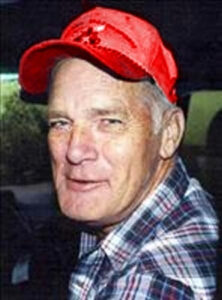
Blythe’s eldest son, Henry Leon Blythe, never knew his biological father or paternal siblings. After their divorce, Virginia Gash moved to California and married first a man named Coffelt, then a man named Charles Ritzenthaler. She had lost touch with Blythe when their son was an infant, after he briefly married and then divorced her sister. Later in life, Henry Leon Blythe took the name Henry Leon Ritzenthaler in honor of his stepfather. Henry ran several small businesses in Paradise, California, including a janitorial business, dying in 2009. He was unaware of his connection to the future president until the 1992 presidential campaign, when an investigation by The Washington Post, based on birth registry records, revealed details about Bill Clinton’s family. Ritzenthaler met his half-brother for the first time around that time, and their physical resemblance was remarkable (pictured below left, in Bubba fashion).
Blythe was a traveling heavy equipment salesman for most of his brief career. It was while he worked as a traveling salesman that he met and married all his wives. After his fifth wedding in September 1943, Blythe shipped out for military service in World War II. He was stationed in Egypt and Italy. He worked in a motor pool as a mechanic, repairing jeeps and tanks.
After the war ended, Blythe returned to Hope, Arkansas, to be with his wife. Shortly after he returned, he purchased a house in Chicago and readied it to receive his wife and expected child; he was apparently laying the groundwork for a more settled and conventional married life. Blythe moved to the new house in Chicago while Virginia remained behind in Hope. In Chicago, Blythe returned to his old job as a traveling salesman for the Manbee Equipment Company, which repaired heavy machinery.
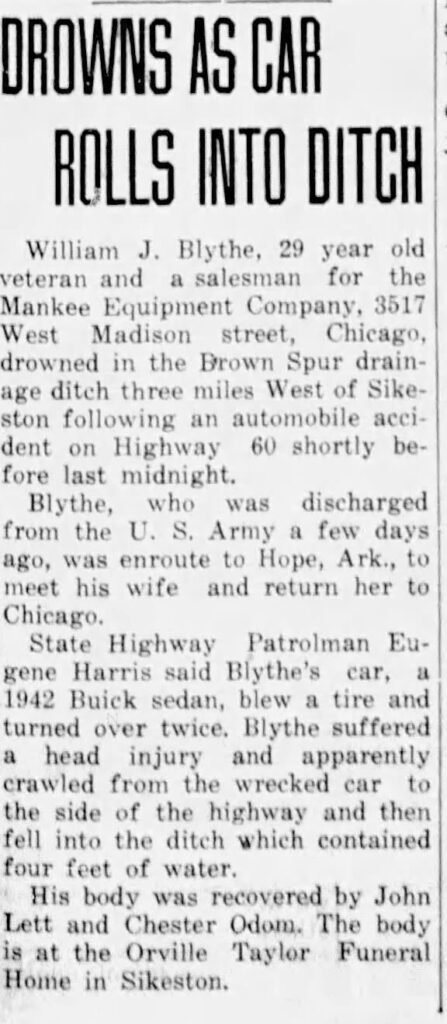
On May 17, 1946, while traveling from Chicago, Illinois, to Hope, Arkansas, Blythe lost control of his 1942 Buick on U.S. Route 60 outside of Sikeston, Missouri, after one of his car’s tires blew out. He survived the crash after being thrown from the car but drowned in a drainage ditch. There were only four feet of water in the ditch. Three months later, Blythe’s widow, Virginia, gave birth to their son, whom she named William Jefferson Blythe III in honor of his father and grandfather. In 1950, Blythe’s widow married Roger Clinton Sr.; 12 years later, Blythe’s posthumous son legally adopted his stepfather’s surname.
“A GUNFIGHT IN FRONT OF CITY HALL*
 “A GUNFIGHT IN FRONT OF CITY HALL*
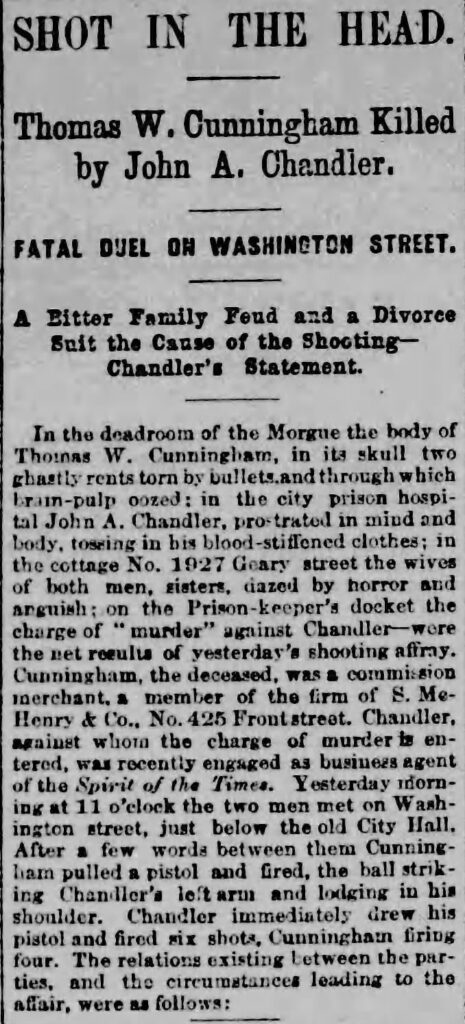
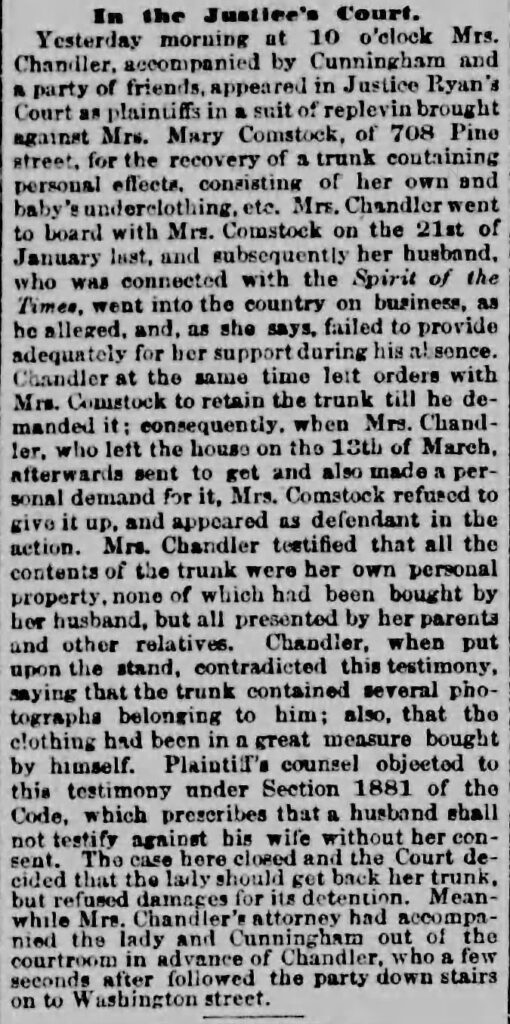
One of our client’s ancestors, Thomas W. Cunningham, was born about 1850 in TN. Thomas, at 22, married 17-year-old Alice Alban on April 2, 1872. As of 1880, they lived in San Francisco, CA, where Thomas worked as a wholesale commission merchant for the “Spirit of the Times”.
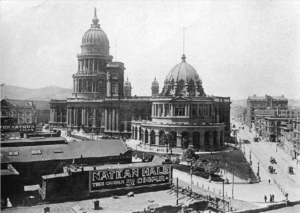
Thomas died on April 22, 1881, in San Francisco, CA, at age 30, from a gunshot wound inflicted by his brother-in-law, John A. Chandler. Apparently, Chandler has been abusing Thomas’ sister-in-law, and there were words between the men, and finally a gunfight where Cunningham drew first (this was 6 months before the famous OK Corral gunfight). The gunfight took place in front of the Old City Hall (pictured above).
CHECKING IN ON GREAT-GREAT-GRANDPA’S CIVIL WAR DIARIES
 CHECKING IN ON GREAT-GREAT-GRANDPA’S CIVIL WAR DIARIES
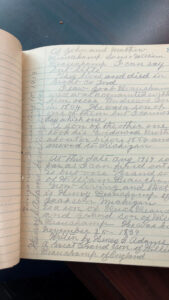
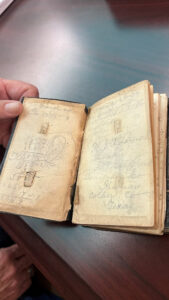
Back in August, I wrote about donating my Great-Great Grandfather’s Civil War diaries to the U.S. Grant collection located at the Mitchell Memorial Library at Mississippi State University. U.S. GRANT LIBRARY
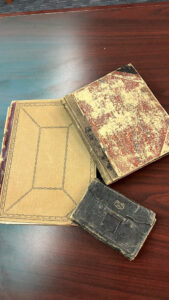
This year, our journeys took us through Starkville, and I figured I’d check to see how the diaries were doing. It turns out just fine, as they were all in a Gaylord Archival Box and the smaller items were sleeved in protective sheets.
As you can see, there were actually three diaries. The small one he carried in the war, the larger one he used after the war, and a medium-sized one used before, during, and after the war.
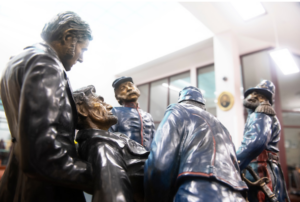
We also visited the U.S. Grant Presidential Library, the extensive Frank and Virginia Williams Collection of Lincolniana, one of the nation’s largest private Lincoln research collections, located on the 4th floor of Mitchell Memorial Library. Donated in 2017, it includes thousands of artifacts, rare documents, and statues, with special exhibits—including 2025 featured displays on Lincoln’s assassination (including the adjacent pictured sculpture, a Moody Tearful Night); and the Charles H. Templeton Music Museum, which is renowned for its extensive collection of over 200 self-playing musical instruments, 22,000 pieces of sheet music, and 15,000 recordings, documenting the “Business of Music” from the late 19th to early 20th centuries.
PRESERVE YOUR FAMILY HISTORY, TODAY
 PRESERVE YOUR FAMILY HISTORY, TODAY
Reach out to Dancestors Genealogy. Our genealogists will research, discover, and preserve your family history. No one is getting any younger, and stories disappear from memory every year, eventually fading from our ability to find them.
Preserve your legacy and the heritage of your ancestors.
Paper gets thrown in the trash; books survive!
Ready to embark on your family history journey? Don’t hesitate. Call Dan Nelson and get your project started!
