

05 Dec Genealogy Newsletter- December 13, 2025
Contents
 BALLING IN THE GRAND CANYON
 BALLING IN THE GRAND CANYON
In 2011, we backpacked west of Grand Canyon National Park, into the Havasupai Indian Reservation. At the end of the trail lies the village of Supai on the valley floor of the Grand Canyon. It’s a short hike to the beautiful Havasu Falls, and you can even continue onto the Colorado River. We spent the day swimming in, about, and under the falls pool.
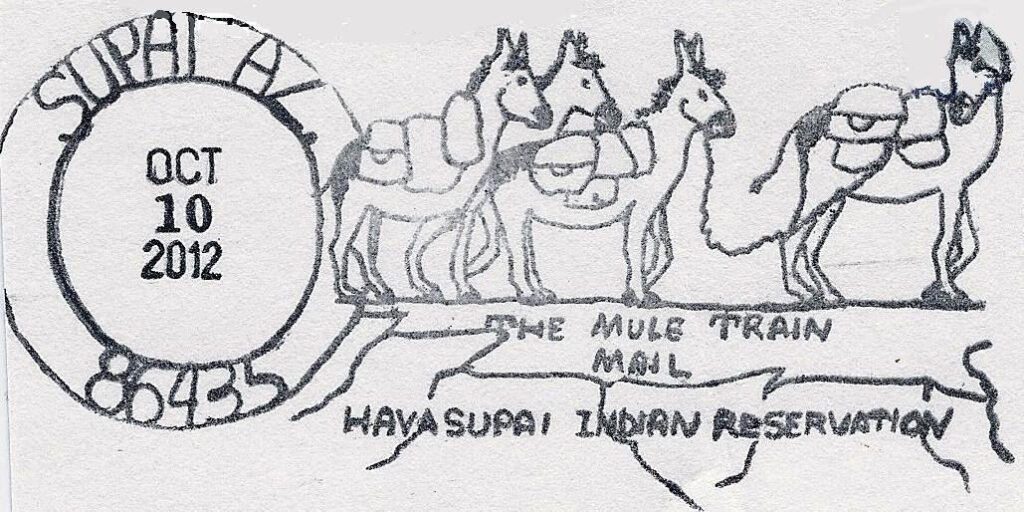
As of the 2010 census, they had a population of 208. The capital of the Havasupai Indian Reservation, Supai, is the only place in the United States where mail is still carried in and out by mules. The US Mail stores perishable goods in a walk-in freezer at the Peach Springs, Arizona, post office while they await being loaded onto mules. According to The Smithsonian, the Peach Springs post office is the only one in the country with a walk-in freezer.
Supai has been referred to as “the most remote community” in the contiguous United States by the U.S. Department of Agriculture. It is accessible only by helicopter, on foot, or by mule. Supai is 8 miles from the nearest road and has no automobiles in the community. They do have the Havasupai Lodge, which is a Motel 6-class (being generous) place, but most people stay in tents in the campground.
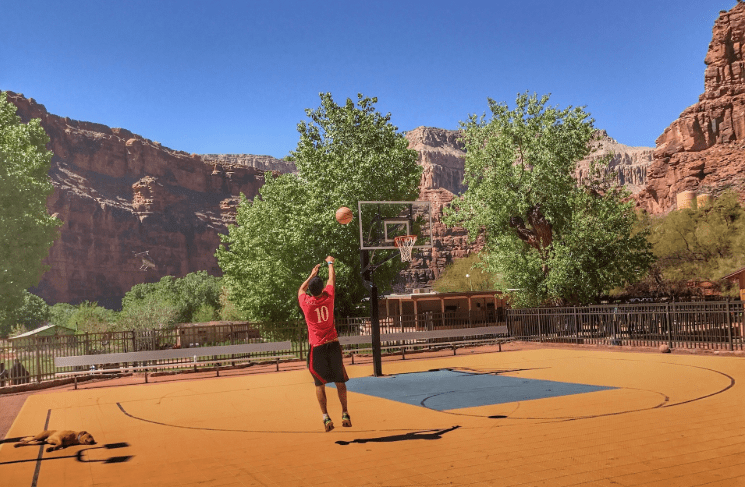
The village consists of a grocery store, café, church, a school (K-8), a clinic, and an outdoor basketball court with rubber decking; the rest are private homes. It’s a bit surreal, with donkeys, mules, and dogs running loose, braying, barking, and dust flying. The houses are smartly surrounded by chicken wire to keep out trouble and keep the chickens safe.
Besides the twice-a-week helicopter deliveries of supplies, the only nod to the modern world is a splash of satellite dishes.
Our hike was during the 2011 National Basketball Association conference finals. Two of my hiking buddies were CA state high school basketball champions. As we hiked back into the village, we saw a pick-up basketball game being played (see the court below) and came up with a plan where my buddies were going to ask if they could play, and then if they built a friendship with the players, they would ask where we could watch that night’s Lakers vs. Mavericks game. They played as well as two old guys in hiking boots could against much younger competitors, but they found out that we could likely watch the game at Miss Dotty’s house, who they said was a good Christian and a serious basketball fan. Our kind of people!
So, after dinner, we went to Miss Dotty’s gate with a plan. We all grew up in Southern California, so our early allegiances were to the Lakers, but two of us had moved to Dallas and were converted Mavericks fans. Our working theory was that Miss Dotty was probably a Suns fan and, once they were knocked out, would most likely be a Lakers fan, as they were the next closest geographically. So, we went to the door and negotiated an invitation for ourselves: Miss Dotty’s nephew, Craig, worked at the clinic, and, with diabetes being epidemic amongst Native Americans, he and my buddy (who is a thought leader regarding the disease) discussed the challenges, and also discovered Craig was a Steelers fan, and followed up by sending him some merch, in recognition of letting us crash their two-person party.
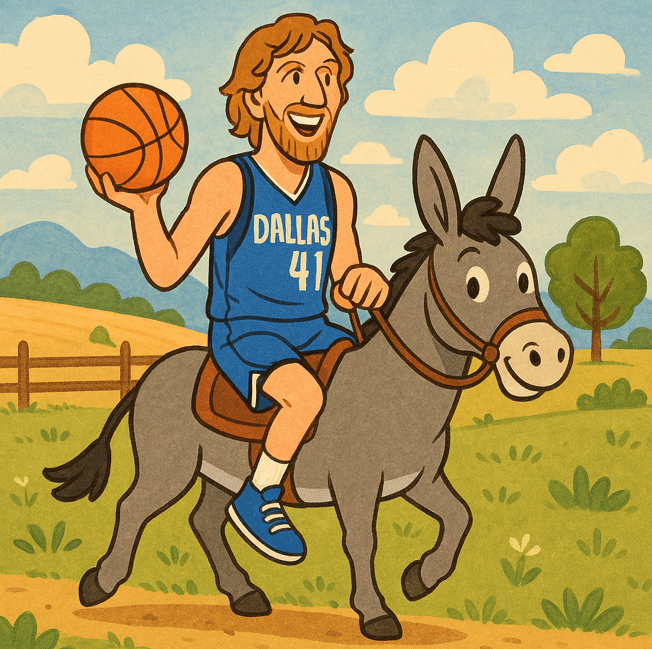
As the pre-game warmups started on the TV, my buddies announced they were Lakers fans, while I sat silent (rare for me). Eventually, my buddy asked Craig who Miss Dotty’s favorite team was, and Craig asked her. Miss Dotty did not speak a lick of English and shared her allegiances in her native language, Havasupai, which has fewer than 1500 speakers worldwide. https://en.wikipedia.org/wiki/Havasupai%E2%80%93Hualapai_language Her explanation involved a lot of clicking and clucking sounds, and ended with the only non-Havasupai, understandable (to us) phrase: “Big German”. Alas, she was a Maverick’s fan in her description of the team’s native German star, Dirk Nowitzki. So, while my buddies had made their declaration as Lakers fans, I could cheer with Miss Dotty! Those of you who are basketball fans know that in 2011, the Dallas Mavericks became the NBA Champions. All thanks to Miss Dotty’s support!
MORE CAPTAIN STARBUCKs
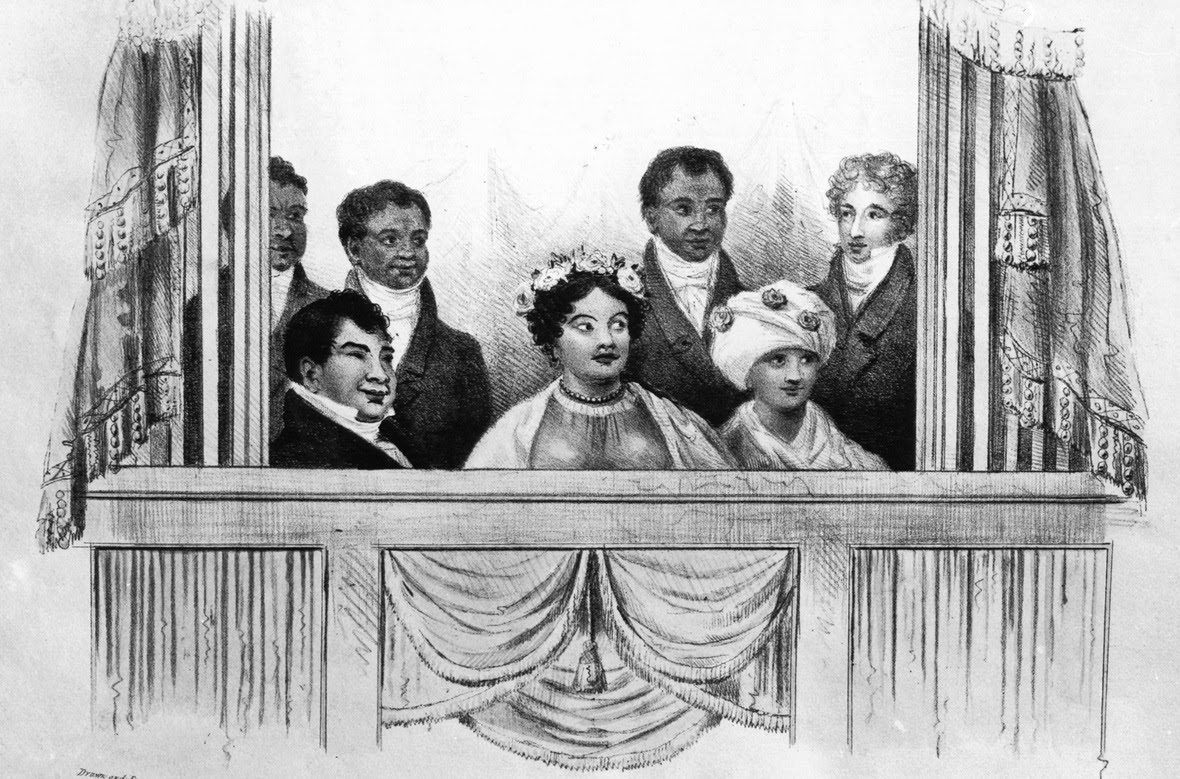
Hezekiah Starbuck had a couple of nephews named Valentine and Obed. Valentine Starbuck was born on May 22, 1791, in Nantucket, Massachusetts. He commanded various whalers in the Pacific. In 1823, while captaining the British whaleship Aigle, he was chartered by Hawaiian King Kamehameha II for a trip to Britain on a state visit. The passengers included Queen Kamāmalu and a few other nobles. The Hawaiian King and Queen (pictured in London in 1824) died of measles while in London, and his employers sued Valentine for not completing his whaling voyage.
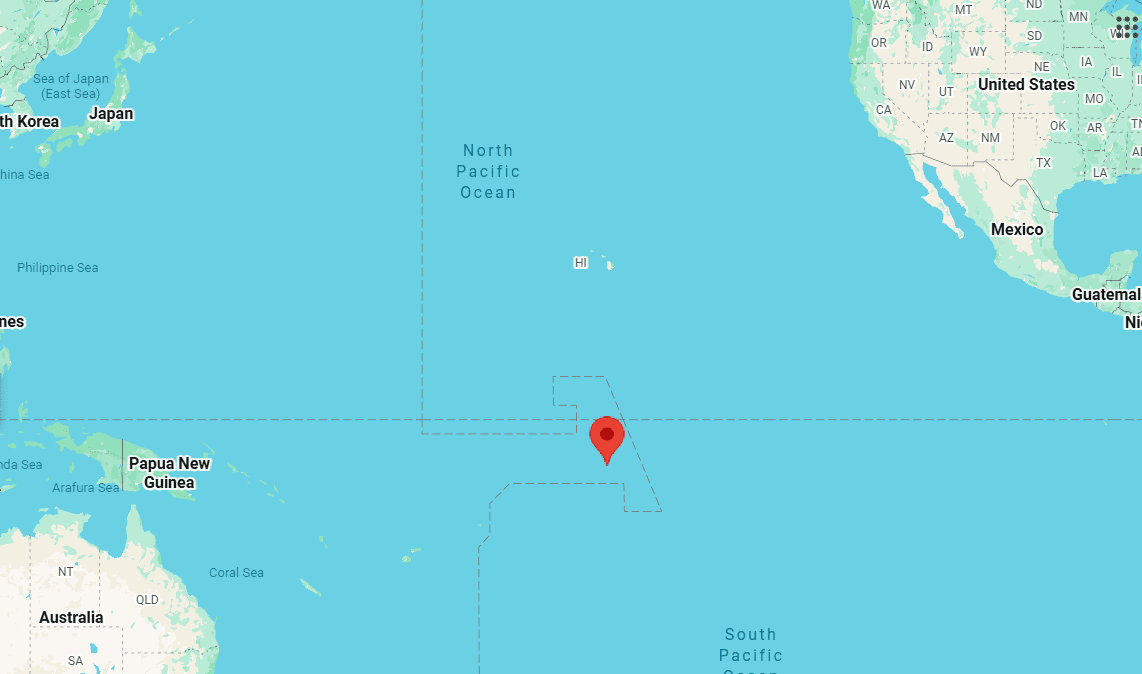
Before his journey to London, Valentine had sighted an island in the Pacific, known as Starbuck or Volunteer Island (shown on the map below Hawaii). When Royal Navy captain George Anson Byron came across this island when returning the bodies of the Hawaiian king and Queen to their homeland on the HMS Blonde (1819), he named the island “Starbuck” in Valentine’s honor. However, his cousin Obed Starbuck had previously sighted the island.
Obed Starbuck (1797 -1882) whaled in the Pacific for many years. Obed made several significant voyages. Sailing on the Hero 1822-1824, which returned to Nantucket with 2173 barrels of sperm oil, he discovered an island on 5 Sep 1823, located at 5°32′ S, 155°5′ W, since known as Starbuck Island (also called “Hero Island”). From 1824 to 1826, Obed captained the Loper. In that vessel, he was the first European to visit an outlying island in the Phoenix group, which he named “New Nantucket,” which, when rediscovered in 1835 by Michael Baker, was renamed Baker Island. Obed named “Loper Island” (Niutao), which Francisco Antonio Mourelle sighted on May 5, 1781. who named Niutao, El Gran Cocal (‘The Great Coconut Plantation’). Obed also named “Tracy Island” (Vaitupu), and various other now-unidentified islands. Based on reported locations, these might include Birnie Island and Sydney Island, previously discovered by Capt. Emmett in 1820, although it is hard to be precise given the bearings provided. On this journey, Obed also completed the mapping of Tuvalu, which Captain George Barrett of the Nantucket whaler Independence II had begun.
MORE ON STEPHEN HOPKINS AND THE MAYFLOWER VOYAGE
In the last edition, I shared Stephen Hopkins’ detour to the New World through Bermuda, then onto Jamestown, and his return to England. His next step was to come back to the New World on the Mayflower. HOPKINS
Hopkins and his family, consisting of his wife Elizabeth and his children Constance, Giles (my ancestor), and Damaris, as well as two servants (Edward Doty and Edward Leister), departed Plymouth, England, on the Mayflower on 6/16 September 1620. The small, 100-foot (30 m) ship had 102 passengers and a crew of about 30 to 40 in extremely cramped conditions. By the second month out, the ship was being buffeted by strong westerly gales, causing the ship’s timbers to be badly shaken, with caulking failing to keep out seawater, and with passengers, even in their berths, lying wet and ill. This, combined with a lack of proper rations and unsanitary conditions for several months, is attributed to what would be fatal for many, especially the majority of women and children. On the way, there were two deaths, a crew member and a passenger. Still, the worst was yet to come after arriving at their destination, when, in the space of several months, almost half the passengers perished in the cold, harsh, unfamiliar New England winter.
On 9 November 1620, after about three months at sea, including a month of delays in England, they spotted land, which was the Cape Cod Hook, now called Provincetown Harbor. After several days of trying to sail south to their planned destination of the Colony of Virginia, strong winter seas forced them to return to the harbor at Cape Cod Hook, where they anchored on 11/21 November. The Mayflower Compact was signed that day. The passengers of the Mayflower argued, as the passengers of the Sea Venture had argued, that they had been freed from their indentures to the Virginia Company and could now choose their own governance. Stephen Hopkins was among the signatories.
Hopkins was a member of the early Mayflower exploratory parties while the ship was anchored in the Cape Cod area. He was well-versed in the hunting techniques and general lifestyle of the Native Americans from his years in Jamestown, a knowledge that proved immensely valuable to the Pilgrim leadership.
The first formal meeting with the natives was held at Hopkins’s house, and he was called upon to participate in early Pilgrim visits with the natives’ leader, Massasoit. Hopkins’s home was used to house Samoset and Squanto. Over the years, Hopkins’s assistance to Pilgrim leaders such as Myles Standish and Edward Winslow, in his knowledge of the local languages, proved quite helpful.
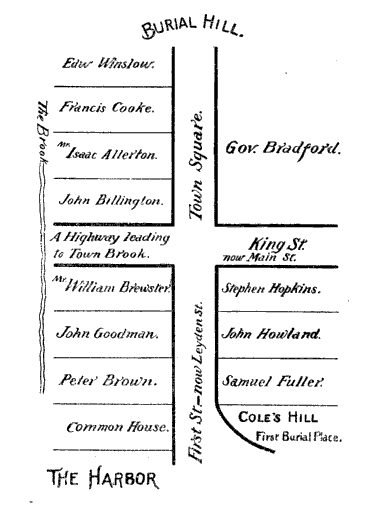
The Mayflower Quarterly of December 2011, in an article on Plymouth-area taverns, has a paragraph on Stephen Hopkins, who kept an “ordinary” (tavern) in Plymouth on the north side of Leyden Street from the earliest days of the colony. The article defines a 17th-century “ordinary” as a tavern offering set mealtimes and prices. Terms such as “inn”, “alehouse”, and “tavern” were used interchangeably with “ordinary” in early Plymouth records.
Hopkins kept this tavern from the early colony days until he died in 1644. In the early 1600s, he also had an alehouse in Hampshire with his wife, Mary, and his mother-in-law, Joan, which they continued to operate after he left for America in 1609.
Hopkins apparently had problems with the Court over his tavern. Plymouth records indicate that Hopkins let “men drink in his house upon the Lord’s day”, “for suffering servants and others to sit drinking in his house” (contrary to Court orders), also to play games “& such like misdemeanors, is therefore fined forty shillings.” In addition, the Court had several charges against him “for selling wine, beere, strong waters, and nutmeggs at excessiue rates, is fyned.”
His home lot in Plymouth is pictured next to the article and is amongst other Mayflower historical figures.
WE WANT TO BE DEPENDENT!
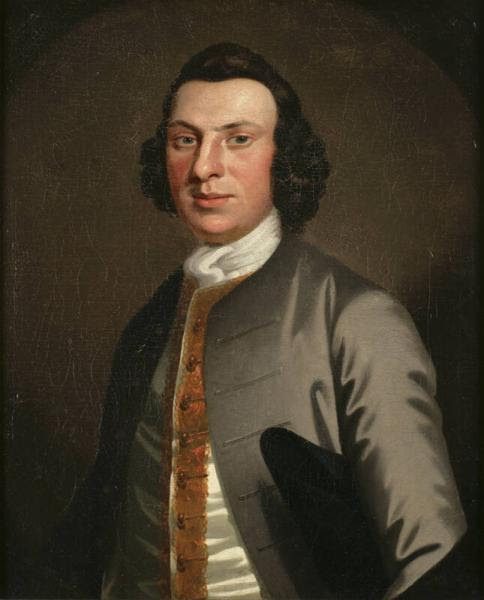
In response to the Declaration of Independence, the Loyalists in British-held New York decided to send a different message, called the Declaration of Dependence. The document was signed over three days, ending on November 28, 1776, at Fraunces Tavern FRAUNCES TAVERN by 547 Loyalists from New York. The signers were merchants, yeomen, freed slaves – basically a mixed bag of people all wishing to remain loyal to the Crown. The Declaration of Dependence has 491 more signatures than its counterpart. Google AI gets confused: when I ask who the 491 signers were, it responds, “There were no signers of a Declaration of Independence in 1776.”
The 242-year-old Declaration of Dependence is owned by the New-York Historical Society Library, and below is a picture of the signing page.
Here is the story of one prominent signer:
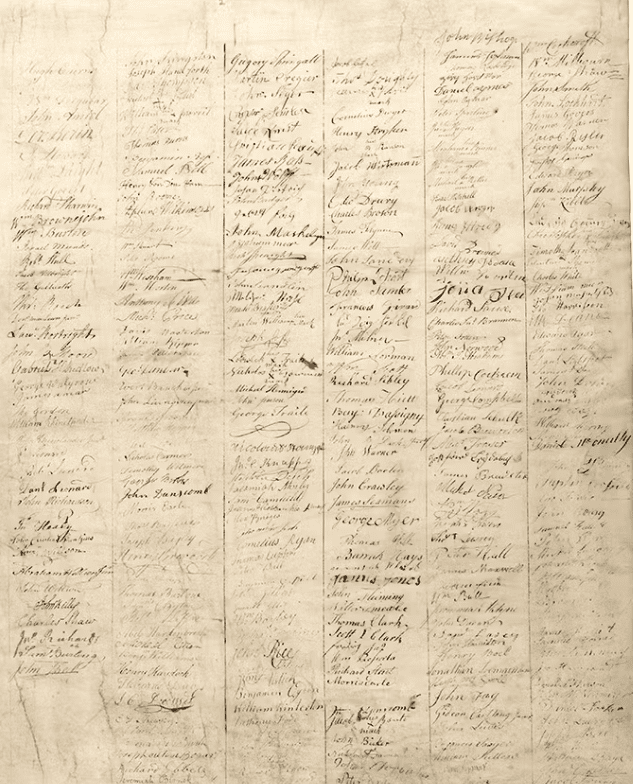
Frederick Philipse III (pictured). The house that Frederick Philipse once occupied is now a Historic Site, the Philipse Manor Hall in Yonkers, New York. The family lived in luxury. Rent from many tenant farmers who worked their lands helped pay for this lifestyle. As those around Frederick Philipse III began to rebel against Great Britain, he defended the Crown. George Washington disapproved of having such a strong-willed Loyalist at large and ordered Frederick Philipse III arrested in 1776, but the Philipse family fled to British-occupied New York. His signature can be seen prominently in the middle of page one, column five. Frederick Philipse III had a sister, Susannah Philipse. She married Col. Bevereley Robinson, a prominent Loyalist officer in whose home Benedict Arnold made his headquarters. From the strong Loyal bonds of this marriage was born Frederick Philipse Robinson, who began his career in the British army as a young officer in the American Revolution and eventually rose to the rank of major general. His portrait is found in the hallway of Queen’s Park, Toronto, Ontario. He was the provisional lieutenant-governor of Upper Canada in 1815. Eventually, the lands and the Manor of Frederick Philipse III were confiscated and sold at public auction by the New York State Legislature. The last “Lord of the Manor” died of a broken spirit and poor health in England in 1786.
JOHN THE PAINTER
 JOHN THE PAINTER
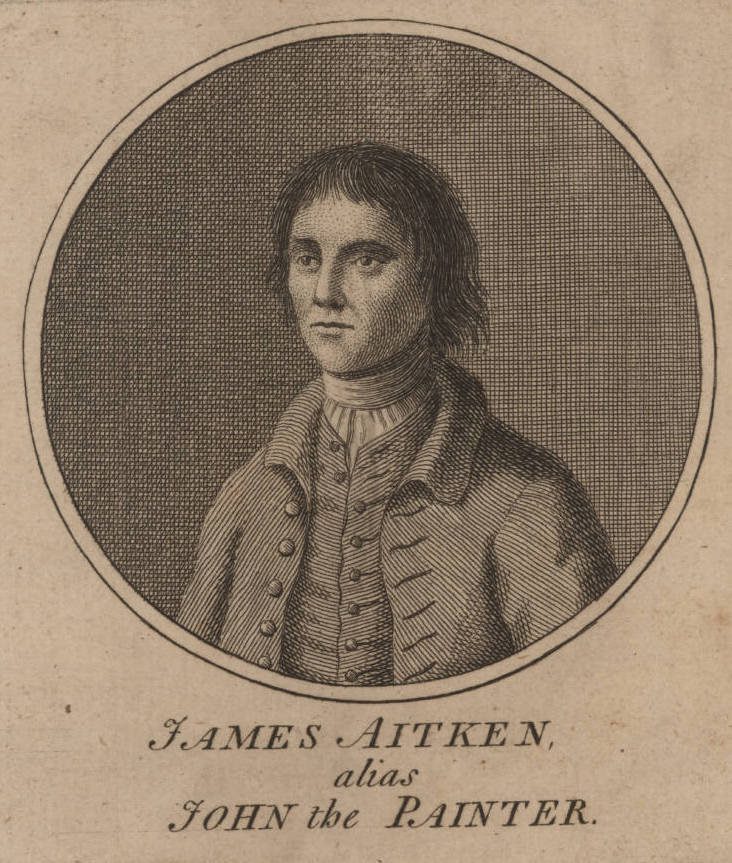
James Aitken was born in Edinburgh in 1752, the son of a whitesmith and the eighth of twelve children. The early death of his father allowed Aitken to enter the charitable school for impoverished children at George Heriot’s Hospital, which was founded to care for the “puir, faitherless bairns” of Edinburgh.
Upon leaving school at age 14, he tried his hand at a variety of low-paying trades, including a 1767 apprenticeship as a painter, before finding that the world of criminal activity offered him more immediate rewards. He admitted in his testament to being a highwayman, burglar, shoplifter, robber, and (on at least one occasion) a rapist:
.. I made the best of my way through Winchester to Basingstoke, intending to return to London. Going over a down near Basingstoke, I saw a girl watching some sheep, upon whom, with some threats and imprecations, I committed a rape, to my shame it be said.
Fearful that his crimes would soon be detected, Aitken negotiated an indenture in exchange for a voyage to Jamestown, Virginia. He had no real intention of serving the terms of the indenture, however, and soon escaped to North Carolina. His next two years in the colonies were spent in Philadelphia, Boston, New York City, and Perth Amboy, New Jersey. It was during this period that he became exposed to revolutionary rhetoric, and Aitken claimed that British troops had harassed him for being a suspected Whig. At some point after a 1775 return trip to England, he developed his scheme of committing political arson.
The British dockyards, Aitken believed, were vulnerable to attack, and he was convinced that one highly motivated arsonist could cripple the Royal Navy by destroying ships in the harbors. Still, more importantly, the dockyards and ropewalks were used to build, refit, and repair the massive Royal Navy fleet. Despite being a wanted fugitive for his other crimes, Aitken travelled freely to several dockyards to determine their vulnerability. Additionally, he travelled to Paris, where he eventually forced himself into a meeting with American diplomat Silas Deane. Although Deane was skeptical that Aitken would be successful, Aitken left the meetings believing that he had the full backing of Deane and the American revolutionary government. Aitken never received remuneration beyond a few pounds that Deane lent him.
Aitken returned to England with Deane’s instruction to meet the American expatriate, spy, and double-agent Edward Bancroft and disclosed at least some of his intentions to Bancroft. Using his training with mixing chemicals and paint solvents from his trade as a painter, Aitken solicited the help of several others in constructing crude incendiary devices with the intention of burning down the highly flammable buildings in the Royal Dockyards. Over the course of several months, Aitken attacked facilities in Portsmouth and Bristol, creating the impression that a band of saboteurs was on the loose in England.
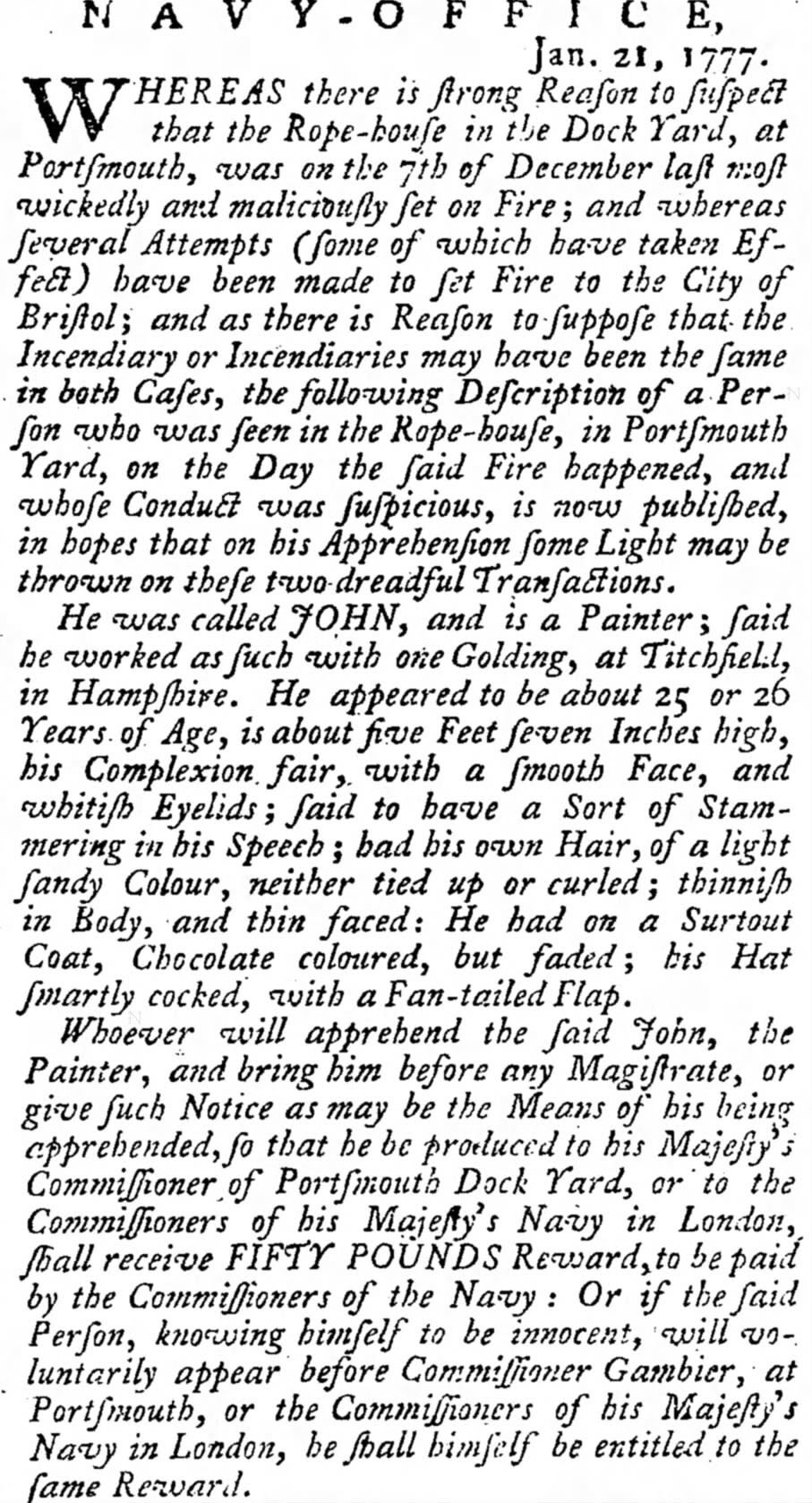
Aitken’s exploits, though only marginally successful in causing meaningful damage, succeeded in generating significant panic among the British public and government. Unsurprisingly, other fires detected during the same period were incorrectly attributed to Aitken, which fanned the alarm. At the height of the crisis, King George III was receiving frequent briefings, and groups such as the Bow Street Runners were on the trail of Aitken. Eventually, through the help of Sir John Fielding, a description of Aitken, naming him “John the Painter,” and a reward for his capture was posted (pictured). Soon after, Aitken was arrested while travelling through the country.
Over the course of his imprisonment, British authorities were initially unsuccessful in gaining sufficient evidence to convict him of the sabotage. However, they soon co-opted John Baldwin, a young former Philadelphia painter, who visited Aitken frequently in prison and eventually gained his trust. Aitken soon provided a great deal of incriminating information to this agent, which was subsequently used to locate witnesses and strengthen the state’s case against him.
British authorities hanged John the Painter on 10 March 1777 from the mizzenmast of HMS Arethusa for arson in royal dockyards after he was caught setting the rope house at Portsmouth on fire. The mast was struck from the ship and re-erected at the dockyard entrance so that as many people as possible could watch the execution. It was the highest gallows ever used in an execution in England. Some 20,000 people reportedly witnessed the hanging. His remains were gibbeted and displayed at Fort Blockhouse for several years.
THE FUTURE FIRST LADY AND THE PANIC OF 1857
 THE FUTURE FIRST LADY AND THE PANIC OF 1857
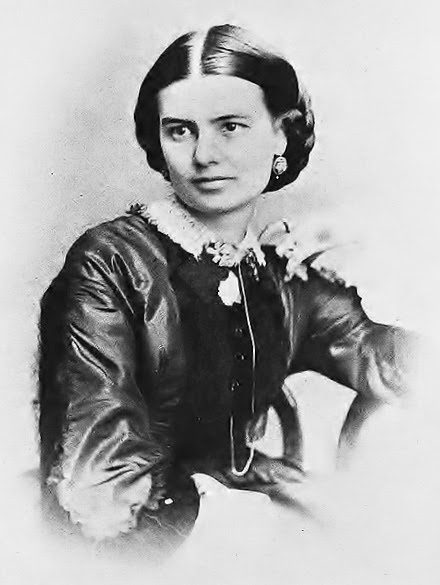
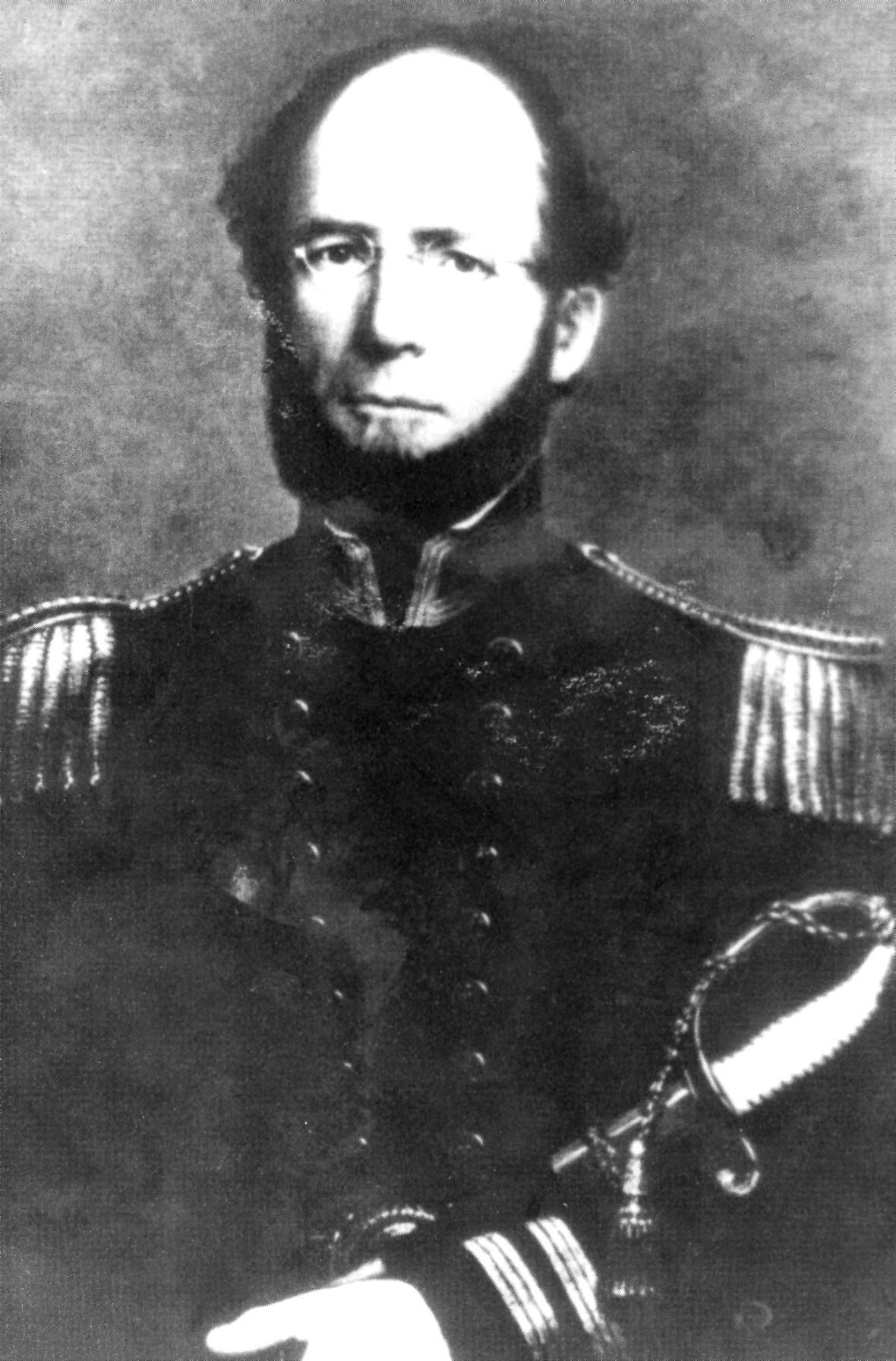
I wrote about President Chester A. Arthur in the last edition. He married in 1859, Ellen “Nell” Herndon, the daughter of Commander William Lewis Herndon (both pictured below), a distinguished officer who had served during the Mexican-American War and explored the Amazon Valley.
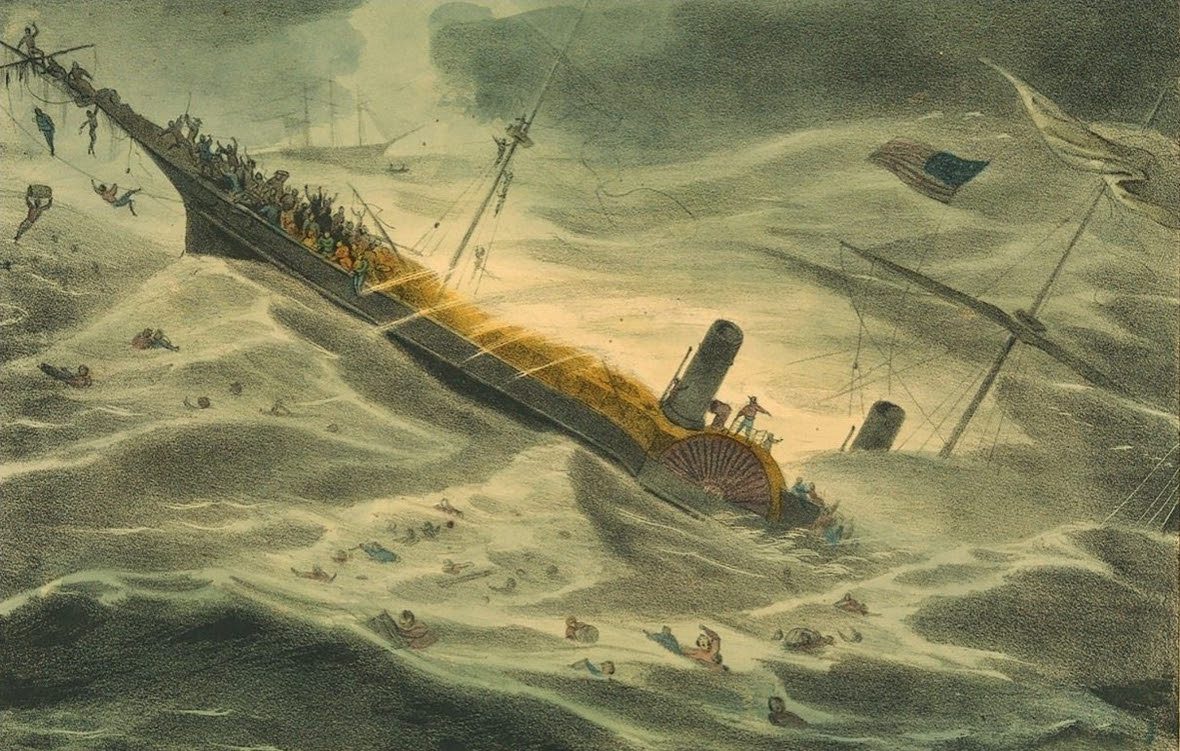
Herndon was also the Captain of the U.S.S. South America. On September 3, 1857, the U.S.S. South America, with 477 passengers and 101 crew, left the City of Aspinwall, now the Panamanian port of Colón, sailing for New York City under his command. The ship was laden with 10 short tons (9.1 t) of gold prospected during the California Gold Rush. The ship continued north after a stop in Havana.
On September 9, 1857, the ship was caught up in a Category 2 hurricane while off the coast of the Carolinas. By September 11, the 105 mph winds and heavy seas had shredded her sails, she was taking on water, and her boiler was threatening to fail. A leak in a seal between a paddle wheel shaft and the ship’s side sealed its fate. At noon that day, her boiler could no longer maintain a fire. Steam pressure dropped, shutting down both bilge pumps. Also, the paddle wheels that kept her pointed into the wind failed as the ship settled by the stern. The passengers and crew flew the ship’s flag inverted (a distress signal in the US) to signal a passing ship. No one came.
A bucket brigade was formed, and her passengers and crew spent the night fighting a losing battle against the rising water. During the calm of the hurricane, attempts were made to restart the boiler, but they failed. The second half of the storm then struck. The ship was on the verge of foundering. The storm carried the powerless ship, and the strong winds would not abate. The next morning, September 12, two ships were spotted, including the brig Marine. Only 100 passengers, primarily women and children, were transferred in lifeboats. The ship remained in an area of intense winds and heavy seas that pulled her and most of her company away from rescue. Central America sank at 8:00 that evening, with a loss of 425 lives. The Norwegian bark “Ellen” rescued an additional 50 from the waters. Another three were picked up over a week later in a lifeboat.
In the immediate aftermath of the sinking, the greatest attention was paid to the loss of life, which was described as “appalling” and as having “no parallel” among American navigation disasters. At the time of her sinking, Central America carried gold valued at approximately US$8,000,000 (2021 value: $765 million). The loss of so much gold helped lead to the Panic of 1857.
PRESERVE YOUR FAMILY HISTORY, TODAY
 PRESERVE YOUR FAMILY HISTORY, TODAY
Reach out to Dancestors Genealogy. Our genealogists will research, discover, and preserve your family history. No one is getting any younger, and stories disappear from memory every year, eventually fading from our ability to find them.
Preserve your legacy and the heritage of your ancestors.
Paper gets thrown in the trash; books survive!
Ready to embark on your family history journey? Don’t hesitate. Call Dan Nelson and get your project started!
